
Third party privacy risk management is the discipline of knowing which outside parties handle personal data you are responsible for, understanding what they do with it, and being able to prove it. In practice, that means verifying that vendors’ actual behavior matches what they claim about data use, sharing, and compliance.
Verizon’s 2025 Data Breach Investigations Report found that 30% of breaches involved a third party, which is twice as much as the prior year. But breaches are just the visible part of the issue. GoodRx paid a $1.5 million civil penalty because its website trackers sent health data to advertising platforms, with no breach at all. In neither case would a security questionnaire have caught it. What failed was everything the paperwork never tested.
Key takeaways
- Third-party privacy risk management means knowing which outside parties handle personal data under your responsibility, what they actually do with it, and being able to prove it. The gap between paperwork and proof is the whole subject.
- Privacy risk is not security risk. The damaging flows are usually authorized: every control works, and the data still leaves, as Avast’s $16.5M FTC order shows.
- Every major regime puts vendor accountability on you: GDPR joint liability where both parties share responsibility for the same damage (Art. 82(4)), CCPA contract duties, HIPAA BAAs, PIPEDA clause 4.1.3. None of these regimes asks for a questionnaire.
- Your contract-vendor list is not your third-party list. Tags, pixels, and SDKs are vendors that no procurement process touched.
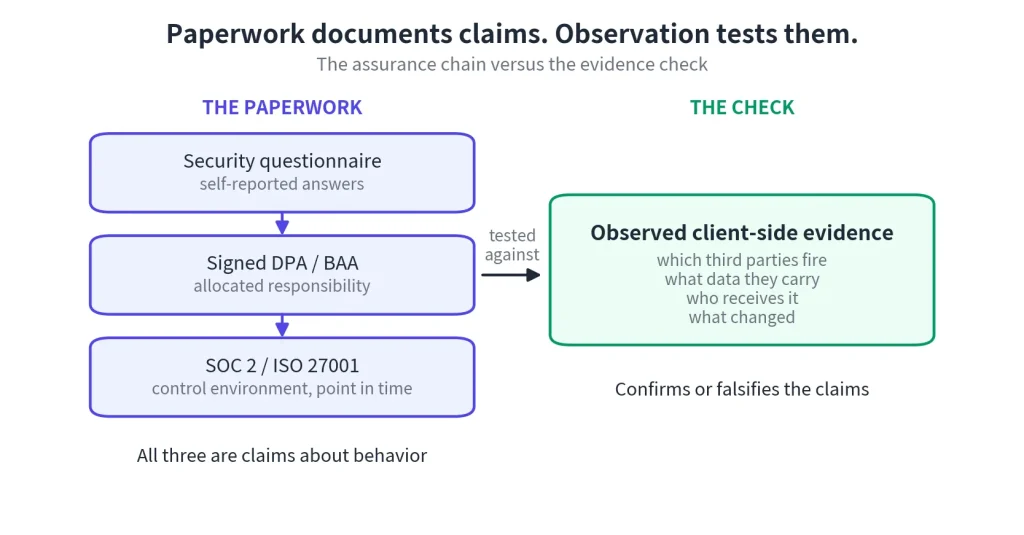
- Questionnaires and certificates document claims. What actually fires, where data actually lands, and what changed since the attestation are only answered by observed evidence.
- Contracts allocate responsibility; they cannot confirm behavior. Clause conformance, the wire versus the paperwork, is the operational check.
- When a vendor incident lands, two clocks run: the vendor’s notice to you, and your 72 hours to the authority. Dated cases put real figures on the exposure.
- The program is six stages (inventory, tier, assess, contract, verify-and-monitor, offboard), with the inventory built from contracts and observed traffic together.
This guide is for DPOs, privacy lawyers, GRC leads, CISOs who manage vendors, and marketing or web owners who see the website as a vendor interface. The main focus is on verification: testing vendor claims against actual observed behavior.
What is third-party privacy risk management?
Third-party privacy risk management covers every external party that processes personal data for you or from you: which parties they are, what they do with the data, and what evidence you hold for both.
Three jobs sit inside that definition. Knowing means an inventory that matches reality, not a contract list, and observed behavior, not stated policy. Proving means evidence you can put in front of a regulator, court, or board.
The GDPR’s own definition of “third party” (Art. 4(10)) is a narrow residual category; the discipline is broader. Here, a third party is any external entity that processes personal data for you or from you, even if there is no contract.
How is privacy risk different from security risk?
Security risk is about whether an attacker can get in. Privacy risk is about what you gave to others on purpose, under what conditions, and if it is used as promised. A vendor might pass all your security checks but still be your biggest privacy risk, because the privacy failure mode is usually authorized: the sharing was the design.
| Security frame | Privacy frame | |
| Core question | Can an attacker get in? | What did we hand over, and is it used as claimed? |
| Failure mode | Breach, intrusion, credential theft | Authorized-but-wrong use: oversharing, repurposing, retention |
| What the audit proves | Controls exist | Only that claims were written down |
| The closing evidence | Logs, pentest reports | Observed data flows |
Avast is a clear example. There was no break-in. Instead, the antivirus company’s own subsidiary collected users’ browsing data and sold it to over a hundred third parties. The FTC’s 2024 order banned this and required $16.5 million in consumer redress. When “used the way we claimed” breaks at scale, it stops being a compliance problem and becomes claim economics, which is its own analysis in wrongful data collection.
What does the law make you answer for?
Every major regime puts vendor accountability on your side of the relationship. But not identically. Under the GDPR and the California Consumer Privacy Act (CCPA), the duties concentrate on you. HIPAA goes the other way: the business associate can be directly liable for its own violations.
| Regime | What the vendor relationship requires | Where liability lands |
|---|---|---|
| GDPR | Controller must “ensure and … be able to demonstrate” compliance (Art. 24); processors need “sufficient guarantees” and a written contract (Art. 28); sub-processors only with prior written authorization | Joint and several: “each controller or processor shall be held liable for the entire damage” where both are responsible for the same damage (Art. 82(4)); a party that proves it was not responsible escapes (82(3)), and a paying party has recourse against the others (82(5)) |
| CCPA / CPRA (California Privacy Rights Act) | Written contract with every service provider or contractor: specified business purposes only, no selling or sharing, no combining personal information, no use outside the direct relationship (§ 1798.140(ag)/(j)); the agreement must grant ensure-and-remediate rights (§ 1798.100(d)) | The business: the contract duties sit on the business’s side of the relationship |
| HIPAA | A business associate agreement with written satisfactory assurances before protected health information (PHI) flows to any vendor acting as a business associate | Split: the business associate is directly liable for its own violations (2013 Omnibus Rule); the covered entity is exposed where the BA is its agent, or it ignored known non-compliance. HHS recognizes no private certification as a substitute (see the certification table below) |
| PIPEDA (Personal Information Protection and Electronic Documents Act) | The organization “is responsible for personal information … transferred to a third party for processing” and must use “contractual or other means” to get a comparable level of protection (Schedule 1, cl. 4.1.3) | The transferring organization, explicitly |
Those duties become the practical compliance requirements you have to translate into contracts, due diligence, and ongoing oversight. Privacy failures also become operational risk when data misuse disrupts workflows or service delivery.
The U.S. state comprehensive laws follow the same controller-and-processor contract pattern. You will meet it almost everywhere. For orientation frameworks, the NIST Privacy Framework organizes the work into five functions (Identify-P, Govern-P, Control-P, Communicate-P, Protect-P). It tells you how to organize, not whether a vendor’s claims are true.
No regime in that table mentions a questionnaire: regulatory compliance asks for guarantees, contracts, and demonstrated compliance under applicable data protection regulations, and the industry’s paperwork grew around those duties rather than from them. That is the core of third-party compliance.
For in-depth CCPA contract mechanics, see the CCPA compliance guide.
Who counts as a third party, and which ones did procurement never see?
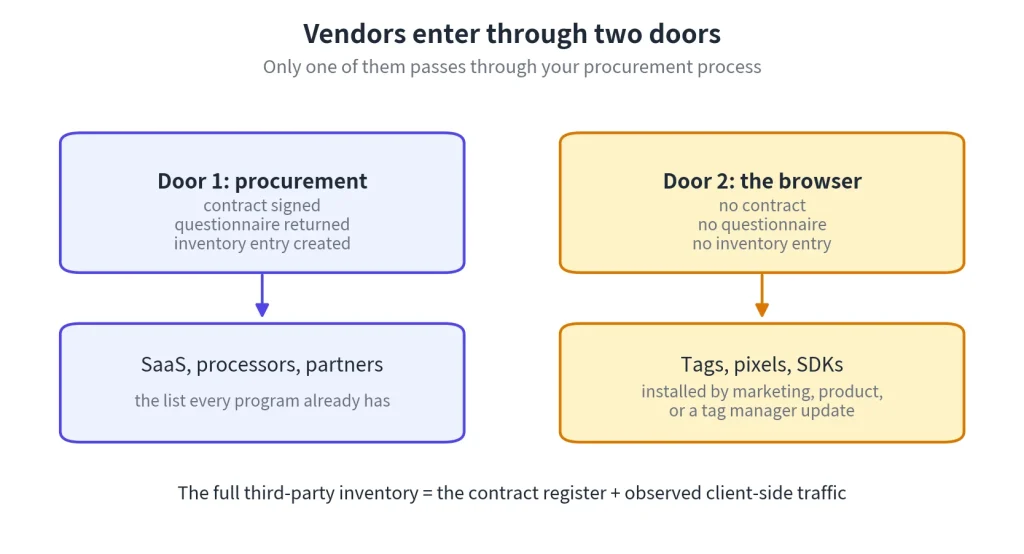
Legally, “third party” is a defined term. Operationally, your third-party population is bigger than your contract list because some entities handling your users’ data arrived through the browser, not procurement.
The legal taxonomy
| Role | What it means | Where defined |
| Controller | Determines the purposes and means of processing; that is usually you | GDPR Art. 4(7) |
| Processor | “Processes personal data on behalf of the controller” | GDPR Art. 4(8) |
| Sub-processor | A processor engaged by your processor, only with your prior written authorization | GDPR Art. 28(2)/(4) |
| Recipient | Anyone to whom personal data is disclosed, whether or not they are a third party | GDPR Art. 4(9) |
| Third party (GDPR) | A residual category: anyone other than the data subject, controller, processor, and authorized persons | GDPR Art. 4(10) |
| Third party (CCPA) | Defined negatively: anyone who is not the business, the service provider, or the contractor | CCPA § 1798.140(ai) |
Note the gap between the two definitions. Under the GDPR, your processors are not “third parties” at all. The CCPA flips the label: “third party” covers everyone outside the contract protections. This page uses that broader working definition throughout.
The vendors your procurement process never sees
Your list of contract vendors is not the same as your list of third parties. The average organization uses 88 IT third parties for operations, which is why unseen external vendors accumulate quickly. Every tag, pixel, SDK, and embedded script on your website is an outside party getting data from your users’ browsers. Most of these were never formally procured, never got a questionnaire, and are not in your inventory. Regulators still see them as third-party vendors, even if they were added by marketing, product, or a tag manager update that no one reviewed.
How they get in
Usually three ordinary routes:
- A tag manager load that chains additional scripts.
- A piggybacking call where one vendor’s tag fires another party’s.
- An SDK baked into an app or page template.
The hop-by-hop mechanics of who receives what, including the difference between what a vendor states and what the traffic shows, are covered in where your data actually goes.
How do you tier vendors by privacy risk?
Tier vendors by what they can touch, not by what you pay them. Contract size is a procurement metric. Privacy tiering runs on data sensitivity, volume, criticality, and observed exposure. The tier sets how deep the assessment goes and helps define each vendor’s risk profile.
| Tier | Criteria | Assessment depth |
|---|---|---|
| Tier 1 (high) | Sensitive data (health, financial, children’s, precise location) OR high volume OR operationally critical OR observed exposure beyond stated purpose | Full privacy assessment + evidence review + contract clause check + continuous monitoring |
| Tier 2 (moderate) | Personal data at moderate volume; standard business purposes; observed behavior matches claims | Full privacy assessment + contract clause check; reassess on trigger events |
| Tier 3 (low) | No personal data, or aggregate/anonymous only; nothing observed firing outside expectation | Baseline questionnaire; annual re-check |
For example, an analytics SDK that gets page URLs with appointment types is always Tier 1, no matter the invoice amount. Payroll is Tier 1 because of the sensitive data involved. An office-supplies vendor that only sets a necessary session cookie is Tier 3. Most existing systems do not include the last factor: observed exposure. That gap hides real risk exposure and makes it harder to identify high-risk vendors early. If a vendor’s tag sends more data than the contract allows, it should be moved to a higher tier, no matter what the paperwork says.
Tiering feeds the six-step exposure assessment in the data privacy risk guide, and it decides how hard the assessment, certification, contract, and verification steps bite.
How do you assess a vendor’s privacy posture, and what can’t the questionnaire verify?
A privacy risk assessment asks questions that a security questionnaire never raises. Even a perfect questionnaire cannot verify the classes of claim that matter most. Run both in that order: ask the privacy questions first, then note which answers still need evidence.
The privacy questions a security questionnaire doesn’t ask
The standard instruments are security instruments. In its 2025 edition, the Standardized Information Gathering (SIG) questionnaire runs to roughly 627 questions across 21 risk domains in Core form. The Consensus Assessments Initiative Questionnaire (CAIQ) is a Yes/No control assertion sheet underlying the Cloud Security Alliance’s (CSA) STAR Level 1. Both are self-assessment instruments, not audits. Neither asks the questions that decide privacy risk:
- Lawful basis and purpose. What is your basis for processing our users’ data, and what purposes will you actually pursue?
- Consent validity. Where the flow depends on consent, how is it captured, scoped, and signaled onward?
- Data subject rights (DSR). How do you handle access, deletion, and portability requests for data we send you? (GDPR Art. 28(3)(e) makes this assistance a contract term.)
- Minimization. What data do you actually need to deliver the service, and what do you take beyond that?
- Retention. How long do you keep it, in what form, and what happens at exit? (Tested at offboarding.)
A data protection impact assessment (DPIA, GDPR Art. 35) covers some of this ground when processing is “likely to result in a high risk,” but it is your assessment of the processing, not the vendor’s answers.
The classes of claim no questionnaire can verify
Three classes of claim sit outside any questionnaire’s reach by design:
- What actually fires. Which scripts, tags, and SDKs execute in your users’ browsers or apps, including the ones loaded indirectly.
- Where data actually lands. The real recipient set, including fourth parties the vendor’s answer sheet does not name.
- What changed since the attestation. Anything that happened after the questionnaire was filled in.
Enterprise security veterans say the quiet part out loud. Andy Ellis, who spent roughly two decades as Akamai’s CSO, on the modern questionnaire:
“Most vendors at this point know how to fake that. Like, oh, we know how to fill out your questionnaire because we have filled out a lot before, and we have our own AI solution that will fill out the questionnaire for us.” (CISO Series transcript, May 13, 2025.)
What evidence review adds (and where it stops)
To go beyond questionnaires, you need observed evidence. This means keeping a record of which third parties actually run on your sites, what data goes to them, and what has changed since you last checked. This page uses observed evidence in that specific sense from here on: client-side observation of real behavior, not a vendor’s attestation about it.
| Assessment domain | What the questionnaire can capture | What it structurally cannot |
| Policies and governance | Stated policies, named DPO, training claims | Whether practice matches policy |
| Data handling | Declared purposes, declared recipients | Actual payloads, actual recipient set |
| Retention and deletion | Declared schedules | Whether deletion happened |
| Sub-processors | Declared list | Piggybacked and fourth-party recipients |
| Change over time | Snapshot at filling date | Drift after the attestation |
What do SOC 2, ISO 27001, and “HIPAA certified” actually prove?
Certifications show that certain controls were in place, according to the vendor’s management, at a specific time or during an audit window. They are silent on what data flows to whom, on purpose creep, and on anything that happened after the audit ended.
| Attestation | What it attests | What it is silent on |
| SOC 2 (Type 1 / Type 2) | Controls relevant to security, availability, processing integrity, confidentiality, or privacy, for the system management describes; Type 1 is design at a point in time, Type 2 is operating effectiveness over a period. Only the security criteria are mandatory; the privacy criteria are optional (AICPA Trust Services Criteria) | Actual data flows, recipients, purposes pursued, anything after the audit window |
| ISO/IEC 27001 | Conformity of the vendor’s information security management system (ISMS) as a management system (ISO) | Product behavior, data-flow behavior, privacy purposes |
| HITRUST (e1 / i1 / r2) | A harmonized control library across 60+ standards, at three assurance levels from foundational (e1) to tailored highest-assurance (r2) (HITRUST) | Same as above: control existence, not data behavior |
| “HIPAA certified” | Nothing. HHS is explicit: it “does not endorse or otherwise recognize private organizations’ ‘certifications’ regarding the Security Rule,” and a certification “does not preclude HHS from subsequently finding a security violation” | Everything; the credential itself is not a regulatory fact |
The “HIPAA certified” myth is not harmless marketing. When the FTC charged GoodRx in February 2023, one count was that the company “displayed a seal at the bottom of its telehealth services homepage falsely suggesting” HIPAA compliance. A badge was treated as a deception in itself.
It is the same gap as the questionnaire, with older ink. Security ratings sit one step further out: they score a vendor’s general attack surface from outside, which says nothing about the question that actually matters: is this vendor leaking ours?
What must the contract say?
The contract is where the legal duties from the law section become operational. Three instruments cover most flows, a short clause list carries nearly all the privacy weight, and one decision rule governs cross-border mechanics: where the data goes decides the mechanism.
Which instrument governs which flow
| Instrument | Which flow it governs | Core privacy terms |
| DPA | A vendor processing personal data on your behalf (GDPR Art. 28(3) makes it mandatory for processors) | Art. 28(3)(a)–(h) content: documented instructions, confidentiality, security, sub-processor authorization, rights assistance, breach/DPIA assistance, delete-or-return at exit, audit rights |
| BAA (business associate agreement) | PHI flowing to a vendor under HIPAA | Written satisfactory assurances of safeguarding; breach reporting; return or destruction at termination |
| DUA (data use agreement) | Data shared between two parties where neither is purely the other’s processor (research, partnerships) | Permitted uses, onward-sharing limits, retention and deletion |
The clauses that carry privacy weight
Whatever the instrument, check for these, in this order:
- Purpose limitation and minimization: what the vendor may do, and the data it may take to do it.
- Breach-notification window: how fast the vendor must tell you; it feeds your own 72-hour clock.
- Sub-processor authorization and veto.
- Audit and inspection rights.
- DSR assistance (Art. 28(3)(e)).
- Delete-or-return at exit (Art. 28(3)(g)), tested at offboarding.
Under the CCPA, the § 1798.100(d) terms from the law table do the same work: limited purposes, same level of protection, ensure-and-remediate rights, and can’t-comply notification.
Where the data goes decides the mechanism
Cross-border mechanics follow the destination. If the data stays in-jurisdiction, a standard DPA is the whole job. Once it crosses borders, GDPR Art. 45 adequacy covers named jurisdictions with no further authorization. Everywhere else needs a transfer mechanism such as standard contractual clauses plus a transfer impact assessment.
What the contract cannot do
A contract sets out who is responsible and what happens if something goes wrong. But it cannot show if the vendor is actually following the rules. The contract’s clauses are just promises, and you need evidence to see if those promises are kept.
Does the observed behavior match the paperwork?
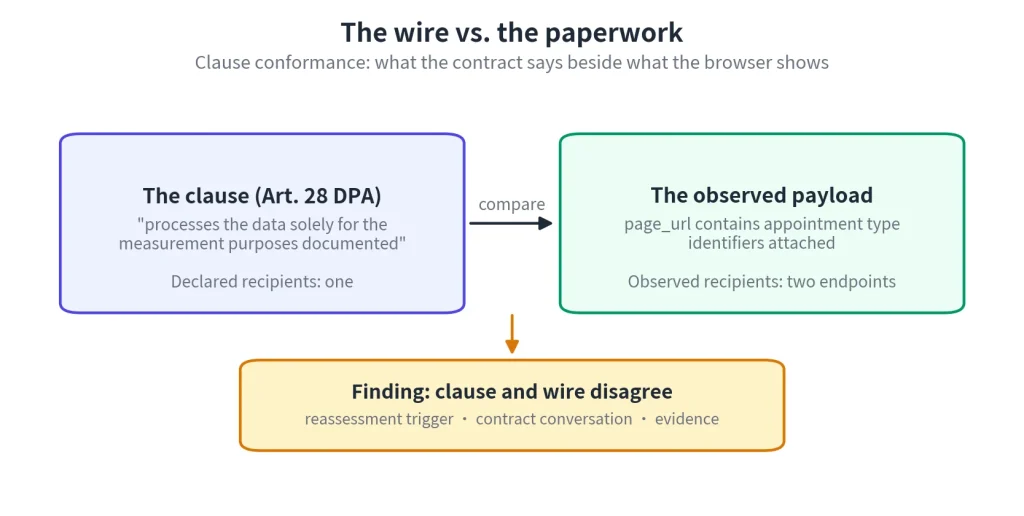
The contract might say one thing, but the browser might show something else. Checking if the contract matches what actually happens is called clause conformance. This changes the question from “is this vendor risky?” to “is this vendor leaking our data?”
The wire vs. the contract
Take the common pattern: the DPA limits an analytics vendor to measurement purposes, and the privacy policy promises users their health-related browsing stays private. Observed client-side traffic either confirms that or falsifies it, payload by payload.
The FTC’s GoodRx order describes exactly this gap: tracking code on the site disclosed users’ prescription medications and health conditions, together with identifiers, to Facebook, Google, Criteo, Branch, and Twilio, while the public promises said otherwise. All the paperwork was fine. The wire, it turned out, was not.
Not “is it risky,” but “is it leaking ours”
Generic vendor-risk scores do not answer the real privacy question. What matters is whether, for the data this vendor handles, their actual behavior matches the stated purpose, the listed recipients, and the retention promises. If you find a mismatch between the contract and what really happens, you have something concrete to discuss, a reason to reassess, and evidence if needed.
How do you keep knowing?
Verification tells you whether a vendor’s claims are true today. Monitoring is how you notice when they stop being true. Every attestation you collected has a shelf life. The reassessment triggers below are the expiry dates.
| Monitoring event | Trigger | Owner |
| Breach notice from the vendor | Contractual notice window (feeds your 72-hour clock) | Privacy lead |
| Sub-processor change | Art. 28(2) authorization or objection window opens | Privacy + legal |
| Vendor policy or terms change | Updated privacy policy, new purposes, new recipients | Privacy ops |
| Observed drift | New tag firing, new recipient, new payload field on your properties | Web/marketing owner + privacy |
| Vendor financial distress | Acquisition, layoffs, distress signals (a security-ratings staple, useful here too) | Procurement |
The last event class is the one attestation-based monitoring cannot see: changes you observe yourself beat changes the vendor eventually discloses.
What about your vendor’s vendors?
Your vendor relationships across the chain come in two kinds:
- The ones the contract chain governs.
- The ones nobody approved.
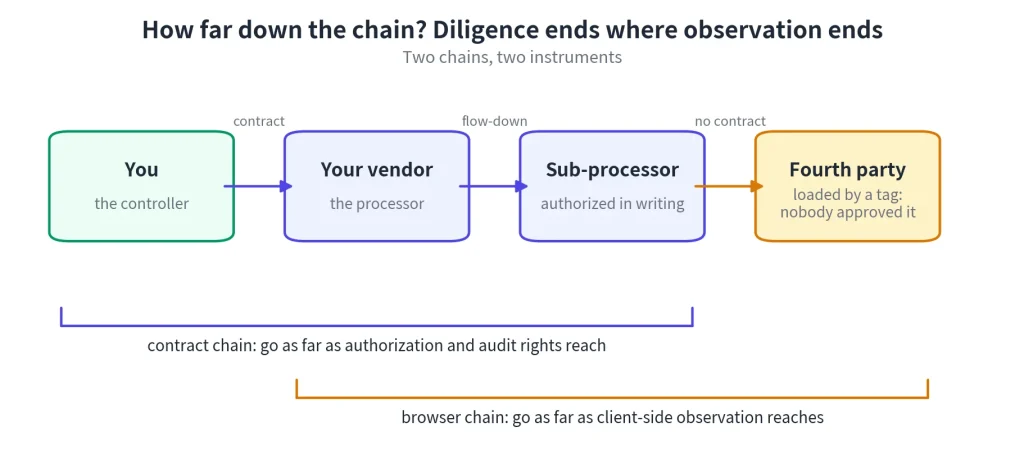
The defensible answer to “how far down the chain do we go” is different for each. Managing third-party relationships gets harder as sub-processors and fourth parties accumulate beyond direct visibility.
For contract sub-processors, the GDPR gives you structure:
No sub-processor without your “prior specific or general written authorization” (Art. 28(2)). The same contract obligations flow down the chain (Art. 28(4)), and “the initial processor shall remain fully liable” for the sub-processor’s performance. Your diligence there is documentary. Authorization rights, notification windows, the current sub-processor list, and flow-down clauses that actually mirror yours.
The browser chain has no such structure. A tag you approved can load a fourth party you never heard of, with no contract, no notice, and no list to check. The operational point here is that nobody approved these parties, so approval-based diligence cannot reach them.
Diligence ends where observation ends. That is the stopping rule. Down the contract chain, you go as far as your authorization and audit rights reach. The browser chain reaches as far as client-side observation does: which recipient classes actually fire and what they receive. Knowing which chain you are looking at, and which instrument reaches it, is the answer.
What about AI vendors?
AI vendors are not a new category of risk. They are a new set of diligence questions on top of everything above. Four questions cover the current exposure:
- Does the vendor train on our customer data? Get the answer as a contract clause, not a sales answer, and check whether “we may improve our services” quietly includes it.
- Which existing vendors quietly became AI vendors? Features ship faster than contract amendments. The vendor you assessed in 2025 may now process your data through a model it added last quarter.
- What did the contract you signed say about it? Pre-2024 DPAs rarely mention model training; silence is not a prohibition.
- What does the EU AI Act change for us? As amended by the Digital Omnibus on AI (Regulation (EU) 2026/1744), the Act applies generally from August 2, 2026, with high-risk obligations phasing in on December 2, 2027, and August 2, 2028. If your vendors’ AI features fall in scope, their compliance becomes your supply-chain question.
Manage your AI risk beyond contracts →
What happens when a vendor causes an incident?
Two clocks start when a vendor privacy incident surfaces: a third-party data breach is your breach, regardless of whose systems failed. Know both clocks before you need them.
Under GDPR Art. 33(2), the processor must notify you “without undue delay after becoming aware” of a breach. Your own clock runs from your awareness: notification to the supervisory authority without undue delay and, where feasible, within 72 hours (Art. 33(1)). The breach-notice window in the contract is what keeps the vendor’s clock from eating yours.
What enforcement and litigation look like, in dated cases with real figures:
| Case (year) | Mechanism | Outcome |
| Target (settlement 2017) | Attackers “accessed Target’s gateway server through credentials stolen from a third-party vendor”: an HVAC contractor, per the Senate Commerce Committee staff report | $18.5M multistate settlement, 47 states + DC; 41M+ payment-card accounts |
| 1&1 Telecom (2019–2021) | Customer-service hotline authenticated callers with name and date of birth alone; BfDI found an Art. 32 violation | BfDI fined €9.55M (Dec 2019); on appeal, the LG Bonn upheld the violation but cut the fine to €900,000 (Nov 2020, final). The violation survived; the headline number did not |
| GoodRx (2023) | Website trackers disclosed prescriptions and health conditions with identifiers to advertising platforms, a vendor-incident pattern with no “breach” at all | $1.5M civil penalty; the FTC’s first Health Breach Notification Rule action; order bans sharing health data for advertising |
| Avast (2024) | Subsidiary sold users’ browsing data to 100+ third parties | $16.5M consumer redress; sale of browsing data for advertising banned |
The FTC’s Bureau of Consumer Protection director, Samuel Levine, framed the Avast theory of harm:
“Avast promised users that its products would protect the privacy of their browsing data but delivered the opposite.” (FTC press release, February 22, 2024.)
Beyond regulators, the fallout runs through your own contracts and operations:
- Indemnification claims against the vendor
- Notification and credit-monitoring costs
- Termination decisions
- DSR fallout when affected users come asking what you hold
Where the sharing was wrongful in the first place, private claim economics apply on top. See the wrongful collection analysis.
How do you offboard a vendor and verify deletion?
Exit is a contract duty with a verification problem attached. GDPR Art. 28(3)(g) requires the processor to delete or return all personal data at the end of the service. The CCPA’s contract terms push in the same direction: no retention beyond the specified business purposes or outside the direct relationship. Paperwork is the easy half.
The exit checklist skeleton:
- Access revocation: credentials, API keys, webhook endpoints, admin accounts.
- Data return: in a usable format, before deletion, if you need it.
- Deletion: including backups on a stated schedule, and the sub-processor cascade (their vendors, not just yours).
- Certificate of destruction: get it in writing.
- DSR fallout check: confirm the vendor’s deletion propagated well enough to answer user requests.
What does the program look like end to end?
The program runs the vendor lifecycle in six stages as a formal risk management framework for third-party privacy oversight, with owners and a cadence: inventory, tier, assess, contract, verify-and-monitor, offboard. Everything covered so far plugs into that spine.
Ownership compresses to a simple rule: privacy leads, with procurement, legal, and security in defined support roles, and the framework should fit the organization’s risk tolerance. Privacy owns the risk register and the assessments, plus the monitoring triggers. Procurement owns intake and renewal hooks, legal owns the clause set, and security owns the technical review where one is needed.
Two structural choices decide whether the program works.
- First, one register and one entry point: spreadsheet inventories scattered across teams and vendors arriving through five different doors are how the browser-delivered class stays unseen, and this is also where due diligence begins for new vendors.
- Second, the inventory step counts both sources, the contract register and the observed client-side traffic.
Each method catches things the other misses: the register does not see browser-delivered third parties, and observation misses data flows that never go through the browser.
The end-to-end checklist:
| Stage | The step | Owner | Cadence |
|---|---|---|---|
| Inventory | Combined register: contract vendors + observed client-side third parties | Privacy + web/marketing owner | Continuous (observed), quarterly (register) |
| Tier | Sort by sensitivity × volume × criticality × observed exposure | Privacy | On intake and material change |
| Assess | Privacy assessment + evidence review, depth per tier | Privacy | Per tier cadence |
| Contract | Clause check against the contract clauses before signature | Legal | Every new vendor and renewal |
| Verify & monitor | Clause conformance + trigger table | Privacy + web owner | Continuous for Tier 1 |
| Offboard | Exit checklist incl. deletion verification | Privacy + IT | Every exit |
How MELURNA helps with third-party privacy risk
At MELURNA, we provide the observed evidence described in this guide. We monitor your properties from the user’s perspective: which pixels, tags, SDKs, and third-party scripts actually run, what data they send, who receives it (including third and fourth parties), and what has changed since the last scan.
For example, your DPA might say the analytics vendor receives pseudonymous identifiers for measurement. A MELURNA scan of the same pages shows the vendor’s tag also transmitting page URLs that contain appointment types, and a second, undeclared endpoint receiving the same payload. That is a clause-conformance finding. Specific, dated, and raised from evidence rather than from another questionnaire.
The observed part of your inventory, the drift events in your monitoring table, and the wire side of clause conformance are the parts we automate.
Book a review slot to see this on your own properties, or read our platform overview.
FAQs
What is third-party risk management?
Third-party risk management (TPRM) is the broader discipline of identifying, assessing, and controlling the risks that outside vendors create for an organization: security, operational, financial, and privacy. It is often called vendor risk management. Third-party privacy risk management is the privacy slice of it, focused on personal data: which parties handle it and on what terms, and whether their actual behavior matches the claims.
Why is third-party privacy risk management important?
Because accountability does not transfer with the work. GDPR Art. 82 makes controllers and processors jointly liable for the entire damage, where each is responsible for the same processing damage. The CCPA puts the contract duties on the business. PIPEDA keeps the transferring organization responsible. In 2020, 80% of organizations faced data breaches from third parties. And the exposure is common: 30% of breaches in Verizon’s 2025 DBIR involved a third party, double the prior year’s share. That is why this matters not only for legal accountability, but also for preserving customer trust.
Which GDPR articles govern vendor management?
Article 24 (controller accountability, “ensure and demonstrate”), Article 28 (processor guarantees, the mandatory contract, sub-processor authorization, flow-down liability), Article 33 (breach notification clocks), Article 35 (DPIAs for high-risk processing), and Article 82 (joint and several liability). Articles 44–49 govern cross-border transfers.
What clauses should a vendor contract include?
Purpose limitation and minimization, a breach-notification window short enough to protect your 72-hour clock, sub-processor authorization and veto, audit and inspection rights, data-subject-rights assistance, delete-or-return at exit, and relevant security controls where the vendor handles sensitive data or systems access. Under the GDPR, these are largely mandatory (Art. 28(3)). For the CCPA, the § 1798.100(d) terms cover the same ground.
How often should we assess vendors?
By tier, through a defined risk assessment process and reassessment cadence, not by calendar alone. Tier 1 vendors (sensitive data, high volume, critical, or observed exposure beyond stated purpose) get continuous observation plus event-driven reassessment, as is standard for high-risk vendors. Lower tiers get annual re-checks plus trigger events: breach notices, sub-processor changes, policy changes, and observed drift, with reassessment depth matched to the vendor’s risk profile.
What is a fourth party / sub-processor?
A sub-processor is a processor engaged by your processor. Under GDPR Art. 28(2), it needs your prior written authorization, and Art. 28(4) keeps your processor fully liable for its performance. A fourth party in the browser sense is different: a party loaded by a vendor’s tag or script with no contract and no notice at all.
Is “HIPAA certified” real?
No. HHS states that it “does not endorse or otherwise recognize private organizations’ ‘certifications’ regarding the Security Rule,” and that a certification does not preclude HHS from later finding a violation. The FTC treated a HIPAA-style seal on GoodRx’s homepage as deceptive in its own right.
How do I verify a vendor deleted our data?
Get the deletion or certificate of destruction in writing, then treat it as a claim, not proof. Ask for the backup schedule and the sub-processor cascade in the same document, since deletion verification is also part of reducing compliance risk after offboarding, and where the flow was client-side, check observed traffic: a tag still firing after deletion is visible from the outside.
DISCLAIMER: This article is for general informational purposes only and does not constitute legal advice. While we strive for accuracy, we make no warranties about the completeness or reliability of this information, and are not liable for any errors, omissions, or actions taken based on its contents. Consult a licensed attorney for guidance specific to your business.