
Data privacy risk is the potential for legal, financial, or reputational harm arising from how an organization collects, uses, shares, retains, or discloses personal data.
A company can pass every security audit and still carry a severe privacy risk. Nothing was stolen. Nobody broke in. The data simply went somewhere it shouldn’t have, to an undisclosed recipient.
This guide focuses on the difference between what you can prove about your security and what you can’t prove about your privacy practices. We’ll cover the types of privacy exposure, why many companies miss them, how regulators and lawsuits turn these risks into costs, and how to measure them.
Key takeaways
- Privacy risk ≠ security risk ≠ breach.
- Risk lives in ordinary, authorized processing. No attacker is required, and statutes like CIPA attach damages without any proof of harm.
- The largest exposure is usually third- and fourth-party, and invisible to contracts. Questionnaires and data-processing agreements record promises, not flows. Your vendors’ vendors are where visibility ends, and liability doesn’t.
- The consequences are current and quantified.
- Exposure is measurable.
- Assessment goes stale. Scripts change, vendors add sub-processors, and AI endpoints appear between audits. Cadence beats intensity; continuous observation beats annual attestation.
What Is Data Privacy Risk?
Data privacy risk is the potential for harm from processing personal data: harm to individuals (lost control, discrimination, embarrassment, unwanted surveillance) that rebounds to the organization as regulatory, legal, financial, and reputational consequences. It exists with or without a security incident. Wrongful collection, inappropriate use, or undisclosed sharing is the risk event itself.
This framing follows the risk model the U.S. National Institute of Standards and Technology (NIST) introduced in NISTIR 8062, An Introduction to Privacy Engineering and Risk Management in Federal Systems. NIST defines privacy risk as the likelihood that a system operation involving personally identifiable information (PII) will create a problem for individuals (a “problematic data action”) and the impact if that problem occurs. Two properties of that model matter for everything else in this guide:
- The trigger is processing, not intrusion. NIST states privacy risks “extend beyond unauthorized access to PII.” Collection, analysis, use, storage, disclosure, and disposal can each create harm on their own.
- Harm affects the individual first. The organization’s exposure (fines, lawsuits, churn, insurance friction) is the rebound of individual harm, not a separate event. NIST’s catalog of non-data-breach privacy concerns includes re-identification of supposedly anonymous data, misunderstood consent, stigma, and discrimination, none of which requires an attacker.
Personal data here means any information linked or linkable to an identified or identifiable person. That covers classic PII (names, identifiers), protected health information (PHI), and behavioral or transactional data such as browsing activity, location pings, and purchase history.
Data privacy laws
The consequence frames are laws: the General Data Protection Regulation (GDPR) in the EU, the California Consumer Privacy Act as amended by the CPRA (CCPA/CPRA), and the Health Insurance Portability and Accountability Act (HIPAA) in the U.S. They convert individual harm into organizational liability.
The cast is wider than those three, and it keeps growing. The GDPR’s reach is matched by the UK GDPR, Brazil’s LGPD, and India’s Digital Personal Data Protection Act. The U.S. has no comprehensive federal privacy law. In its place, twenty states had comprehensive privacy laws in effect by January 2026, with more enacted since, and sectoral federal statutes fill specific lanes: HIPAA for health data, the Gramm-Leach-Bliley Act for financial data, and COPPA for children’s data.
California keeps adding its own mechanics. The Delete Act required the CPPA to open a central deletion mechanism, the DROP platform, by January 1, 2026. Since August 1, 2026, every registered data broker must check it at least every 45 days, delete it on request, and direct its service providers to do the same.
The practical consequence is that obligations multiply across jurisdictions and sectors, which is why the assessment method below maps each flow to the specific instruments it triggers.
Data privacy risk vs. data security risk vs. data breach
The three concepts overlap, but they differ in their trigger, the harmed party, and the consequence. Keeping them separate is the fastest way to spot gaps in a program: strong security controls answer only one column of this table.
| Data privacy risk | Data security risk | Data breach | |
| What it is | Potential for harm from processing personal data – including fully authorized but inappropriate collection, use, sharing, or retention | Potential for unauthorized access, alteration, or destruction of data | A realized security incident: unauthorized access to or disclosure of data |
| Trigger | A processing practice (a pixel, a sharing arrangement, a retention habit) | A vulnerability, threat actor, or control failure | A successful attack or exposure event |
| Who is harmed first | The individual, through loss of control or misuse of their data | The organization and the individual, through compromise of data | The organization and the individual, after the fact |
| Attacker required? | No | Usually yes | Yes (or an equivalent exposure) |
| Example | A hospital website’s ad pixel sends appointment details to an ad platform | An unpatched server holding patient records | Ransomware exfiltrates those records |
| Primary consequence frame | Privacy law (GDPR, CCPA, HIPAA, CIPA) | Security obligations and standards | Breach-notification law, regulator investigations, litigation |
The four variables
Every privacy risk comes down to four main factors. If you change any one of them, the risk changes too.
| Variable | Question | Why it moves the risk |
| Data type | What’s moving? | An email address and a diagnosis carry different consequences |
| Recipient | Who receives it? | A contracted processor, an undisclosed vendor, and a downstream subcontractor sit in three different legal positions |
| Purpose | Why was it sent? | Purpose limitation is a legal requirement, not a preference |
| Jurisdiction | Whose law applies? | The same transfer can be routine in one state and actionable in another |
The recipient does most of the work, and it’s the variable with the least visibility. The collection is deliberately designed to be documented. Recipients accumulate through integrations and vendor defaults, so they don’t.
Why Data Privacy Risk Matters Now and What It Costs
Privacy risk is no longer just an abstract compliance issue. Its consequences are now clear and significant. Regulators issue fines for each violation, law firms file lawsuits over single incidents, and the costs of responding to breaches keep reaching new highs.
Regulatory compliance and fines.
The GDPR’s two fine tiers reach up to €10 million or 2% of total worldwide annual turnover. For infringements of the core principles, consent conditions, data-subject rights, or transfer rules, the ceiling is the higher of €20 million or 4% of worldwide annual turnover (Article 83(4)–(5)).
The Guidelines 04/2022 on calculating administrative fines from the European Data Protection Board (EDPB) confirm that fines must be “effective, proportionate and dissuasive.” They are capped only by those legal maximums.
In the US, the CCPA’s statutory fines are $2,500 per violation, or $7,500 per intentional violation or violations involving minors under 16, and the statute requires the California Privacy Protection Agency to adjust those amounts for inflation on January 1 of every odd-numbered year. The agency’s current adjusted figures, effective January 1, 2025, and in force through 2026, are $2,663 per violation and $7,988 per intentional violation or violation involving minors.
Privacy litigation runs on statutory damages, not proof of loss.
CIPA provides $5,000 per violation or three times actual damages, whichever is greater, without a requirement to show harm. Multiply that across every site visitor. That arithmetic is what turned website tracking into a class-action wave.
Breach response keeps getting more expensive.
The IBM Cost of a Data Breach Report 2026 puts the global average cost of a breach at $4.99 million, up 12% over the prior year. A record high. And insider incidents, a privacy risk as well as a security one, carry their own economics: the Ponemon Institute’s 2026 Cost of Insider Risks study reports an average cost of $747,107 per negligent-insider incident.
The full picture, with dated examples:
| Consequence | Real, dated example | Cost |
| GDPR administrative fine (ceiling) | Statutory maximum, GDPR Art. 83(5) | Up to €20M or 4% of global turnover, whichever is higher |
| Cross-border transfer violation | TikTok, Irish DPC via EDPB (May 2025) | €530M (€485M for transfer failures + €45M for transparency), plus a suspension order |
| Undisclosed sale of personal data | General Motors, California AG (May 2026) | $12.75M, plus a five-year ban on selling driving data to consumer reporting agencies |
| Excessive retention (stale backups) | Blackbaud, California AG (June 2024) | $6.75M |
| Insider misuse (HIPAA) | Montefiore Medical Center, HHS OCR (Feb 2024) | $4.75M settlement + corrective action plan |
| Average breach response (benchmark) | IBM Cost of a Data Breach Report 2026 | $4.99M global average, +12% year over year |
| Orphaned access after departure | Illuminate Education, California AG (Nov 2025) | $3.25M |
| Opt-out mechanisms that fail | Disney, California AG (Feb 2026); Tractor Supply, CPPA (Sept 2025) | $2.75M; $1.35M |
| Tracker sharing of sensitive inferences | Healthline Media, California AG (July 2025) | $1.55M + ban on sharing condition-revealing article titles |
| Privacy-rights request friction | American Honda, CPPA (March 2025) | $632,500 |
| Tracker litigation (statutory rate) | Cal. Penal Code § 637.2 | $5,000 per violation, no actual damages required |
| Negligent-insider incident (benchmark) | Ponemon Institute, 2026 Cost of Insider Risks | $747,107 average per incident |
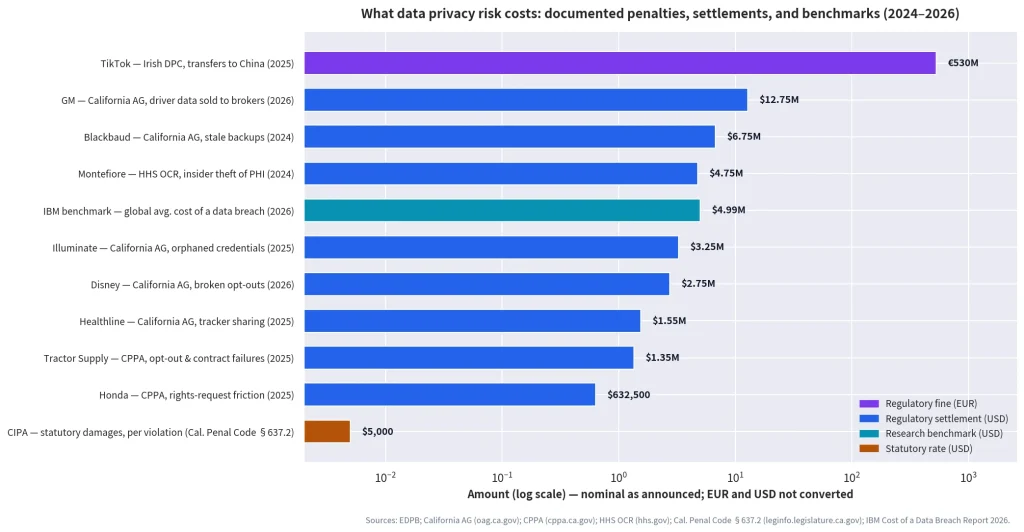
Figure: documented, dated figures only. Nominal amounts as announced; euro and dollar amounts are not converted. Sources: EDPB, California AG, CPPA, HHS OCR, Cal. Penal Code, IBM.
Three features of this table deserve a second look:
- Per-violation math changes the risk equation. Exposure is not proportional to the number of records lost in a future breach. It is proportional to processing practices running now: every visitor, scan, and request mishandled.
- The costliest recent cases are privacy cases, not breach cases. The largest 2025–2026 actions in the table (TikTok, GM, Disney, Healthline, Tractor Supply) concern transfers, sharing, and broken opt-outs, not intrusions.
- These same figures are important in insurance discussions. For underwriters and brokers, the risk of statutory fines per violation and how a company manages trackers and vendors now play a big role in whether insurance renewals go smoothly. Putting a dollar value on exposure, instead of just describing it, helps both boards and insurers make decisions.
This is the lens Melurna’s privacy threat intelligence surface is built around: scoring flows by what data travels and where it lands, so exposure can be priced rather than guessed.
How data privacy risk actually happens
Most privacy risks come into an organization through everyday, approved tools like tag managers, analytics contracts, or chat widgets. After that, the data often travels further than anyone has tracked. The real risk is not just with the vendors you know, but with the vendors your vendors share data with.
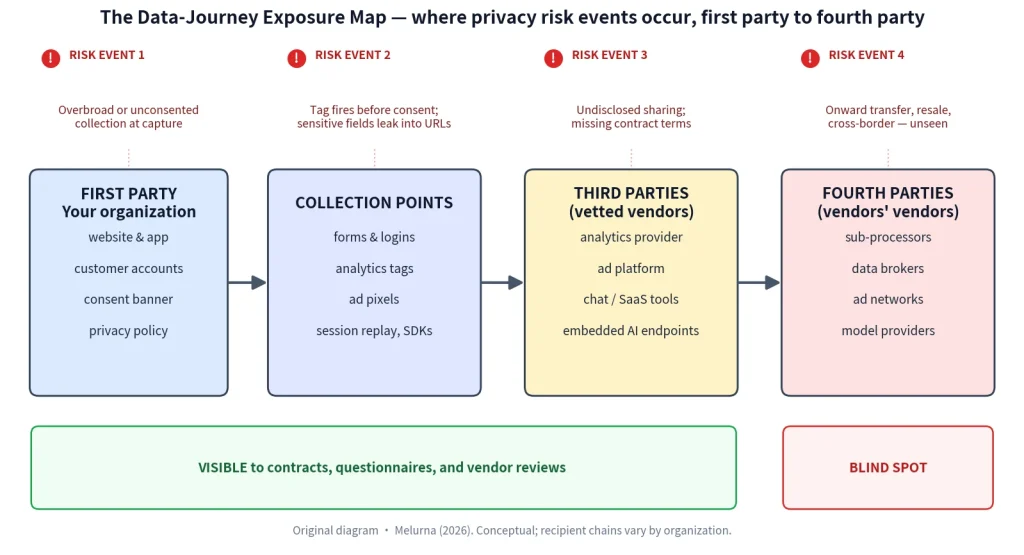
Figure: The Data-Journey Exposure Map. Contracts, questionnaires, and vendor reviews cover the first hops; the fourth-party hop is where visibility ends.
Where sharing begins
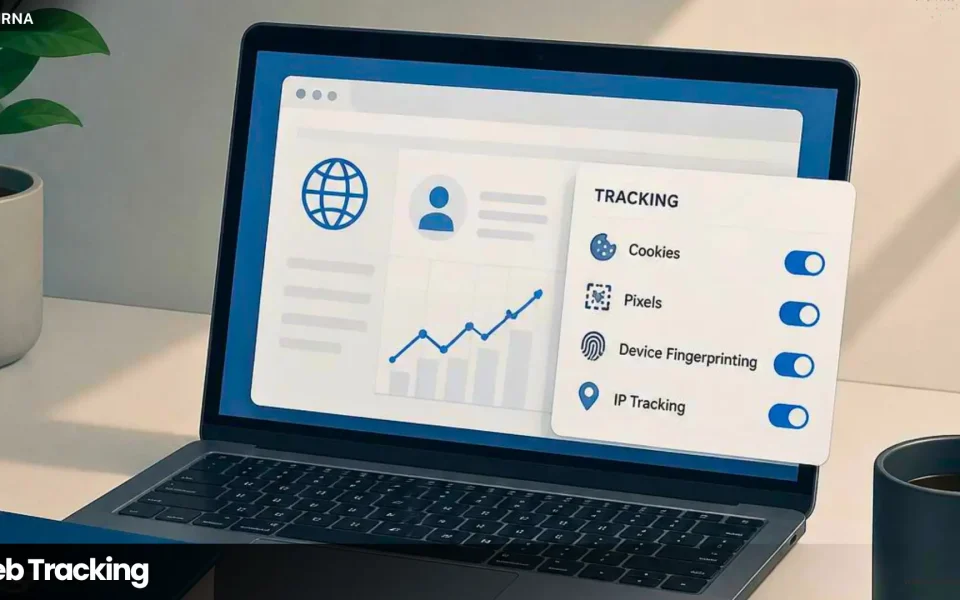
The process begins on your own website or app. Every form, login page, and checkout collects personal data directly, and this part is usually visible and managed. Sharing starts when third-party code is added to your site. These recipients include analytics tags, ad pixels, session-replay scripts that record user activity, chat widgets, SDKs in mobile apps, and now, embedded AI features that process user text or behavior.
Each of these tools acts as a data recipient inside your users’ browsers and devices. For example, a pixel doesn’t check with your server before acting. It can read the page, and in some cases, even see what users type into forms or which buttons they click.
The fourth-party problem
A third party is any external recipient you share data with directly, like your analytics provider, ad platform, cloud vendor, or AI service. A fourth party is anyone they share your data with, such as sub-processors, ad networks, data brokers, model providers, or resellers. You usually don’t have a contract with these fourth parties, and often you don’t even know who they are.
This hop carries real regulatory and litigation exposure because accountability does not travel as far as the data does. When the California Attorney General settled with General Motors for $12.75 million in May 2026, the allegation was that GM had sold driving and location data collected through its connected-car service to two data brokers. The brokers used it to build driver-rating products; sales, the state said, were never disclosed to consumers.
The settlement with DoorDash for $375,000 in February 2024 involved a marketing cooperative: customer data contributed for one purpose ended up disclosed to non-participant businesses, including a data broker that resold it repeatedly. In both cases, the organization had a relationship with the first recipient. The exposure materialized downstream.
If a vendor leaks or resells your customers’ data, regulators and lawsuits usually come after you first. You collected the data and picked the vendor. Contracts might help you recover costs later, but they won’t stop you from getting enforcement notices or negative headlines.
Why vendor questionnaires and contracts fail
Vendor risk management relies on two instruments, the due-diligence questionnaire and the data-processing agreement, both of which share the same structural flaw: they record what a vendor says, not what the vendor’s code does.
- Contracts record promises, not flows. A data-processing agreement signed in 2023 cannot describe a sub-processor added in 2025, a tag fired before consent, or an AI feature switched on by default. The CPPA’s Tractor Supply decision ($1.35 million, September 2025) cited the company for disclosing personal information without required contracts.
- Scripts change without notice. Tags update themselves. Pixels piggyback on other pixels. SDKs phone home to endpoints not in the original integration. A point-in-time questionnaire becomes stale the moment a vendor ships a release.
- Fourth parties are invisible to both instruments. You cannot send a questionnaire to an entity you do not know exists.
One example from our observed data
In recent research, Melurna recorded a test sign-up on klaviyo.com and watched where the data went. The sign-up form had no method attribute, so when the browser made a native submission, it defaulted to GET and serialized every field, including the password, into the page URL. Public web archives show the vulnerable form was in place from at least February 2024 through November 2025.
The credential-bearing URL was transmitted to 31 third-party hostnames: advertising, analytics, and marketing tools operated by Google, Meta, LinkedIn, HubSpot, Spotify, and others. Four of those hostnames returned the test password inside their own responses, confirming receipt rather than mere transmission.
In a second finding, opening a customer profile in a Klaviyo account wrote the contact’s name and email address into the page title and URL, exposing sensitive information to routine tags that then carried it to Sift, Gainsight PX, Google Analytics, Sentry, and Statsig. Sift, Gainsight, and Google Analytics do not appear on Klaviyo’s published list of sub-processors.
No attacker was involved, no system was breached, and no questionnaire would have caught it, because every flow ran on a fully working page. Klaviyo confirmed the findings and remediated them before publication. It told TechCrunch that the known affected count was fewer than 200 people, based on its retained logs. Nor is the underlying omission exotic: the same pattern, a credential- or PII-bearing form without a method attribute, appeared on 7,874 of the top 100,000 websites Melurna measured.
That is what the traffic side sees. Melurna’s platform approaches the problem from that side. It uses agentless observation of browser and application traffic to identify linkable values and resolve the actual recipients of each flow (first-, third-, and fourth-party), preserving the evidence chain from collection point to destination.
Each data flow is rated based on the data’s sensitivity and the risk associated with where it goes, and then checked against data privacy regulations’ requirements. Cross-border transfers are flagged. The main goal is to have solid evidence, not just rely on tools. Risks are found by watching how data moves, not by asking vendors to confirm what they do.
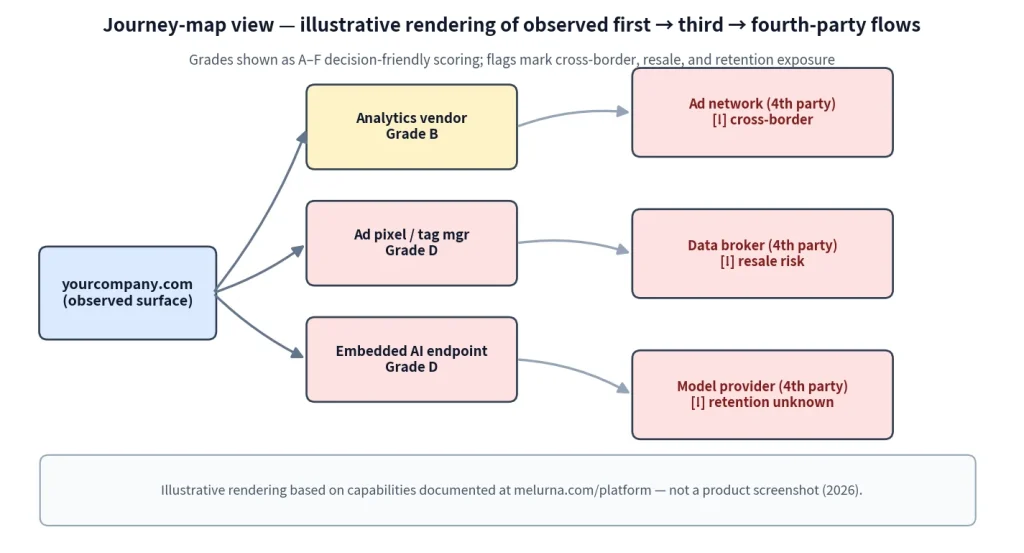
For general counsel, the biggest legal risk comes from the gap between what contracts say and what actually happens with data. This is the gap that lawsuits over tracking often target, and the enforcement cases above show how costly it can be.
Common data privacy risks, with real examples
It’s easier to manage privacy risk when you can name it. These ten categories show the most common ways privacy risk appears in mid-sized and large organizations.
| # | Risk | Mechanism (one line) | Real, dated example |
| 1 | Unauthorized third-party tracking | Pixels, session replay, and SDKs transmit visitor data without valid consent | Healthline: $1.55M, CA AG, July 2025 |
| 2 | Fourth-party vendor flows | Your vendors share onward to brokers and sub-processors you never vetted | GM: $12.75M, CA AG, May 2026 |
| 3 | Overcollection & sensitive-data misuse | Collecting more than needed, or collecting sensitive classes carelessly | Hospital Meta Pixels: 33 of top 100 hospitals, The Markup, 2022 |
| 4 | Shadow AI & embedded AI endpoints | Unsanctioned AI tools and AI features inside SaaS create new, unmapped recipients | AI-driven attacks up 56% – IBM, 2026 |
| 5 | Insider misuse | Employees or contractors access sensitive data or take data beyond their role | Montefiore: $4.75M, HHS OCR, Feb 2024 |
| 6 | Overprivileged & orphaned access | Access accumulates; departures don’t revoke it | Illuminate: $3.25M, CA AG, Nov 2025 |
| 7 | Misconfiguration & unmanaged exposure | Public servers, broken opt-outs, misconfigured tags | Disney: $2.75M, CA AG, Feb 2026 |
| 8 | Excessive retention (ROT) | Redundant, obsolete, trivial data kept “just in case” | Blackbaud: $6.75M, CA AG, June 2024 |
| 9 | Cross-border transfer exposure | Data lands in jurisdictions without adequate safeguards | TikTok: €530M, Irish DPC/EDPB, May 2025 |
| 10 | Compliance drift | Policies age; the wire changes; paperwork and practice diverge | Tractor Supply: $1.35M, CPPA, Sept 2025 |
How organizations assess data privacy risk
Assessment is how data privacy risk stops being a narrative and becomes a number. The method below has six steps, plus a scoring framework. It reflects the structure of the established instruments (DPIA, PIA, and third-party risk assessments, unpacked below) and follows the NIST privacy risk model: likelihood of a problematic data action, multiplied by its impact.
Step 1: Map the data flows.
Inventory how personal data actually moves: collection points, internal uses, third-party recipients, fourth-party onward transfers, cross-border destinations, and retention. Build the map from observed behavior where possible. Records of processing activities (RoPA), the formal inventory of your data processing activities, and questionnaires are starting points, not ground truth, for the reasons covered in the journey section.
Melurna’s platform automates this. It builds the map from observed browser and application traffic and keeps it up to date as scripts change.
Step 2: Identify the risk events.
For each data flow, consider what could harm individuals. Possible risks include collecting data without proper consent, sharing it for reasons not disclosed, keeping it longer than needed, transferring it without safeguards, or re-identifying supposedly anonymous data. NISTIR 8062 calls each of these a “problematic data action,” linking risk to a specific activity instead of a general system.
Step 3: Score likelihood × privacy-weighted impact.
Rate each risk event on likelihood (1–5) and impact (1–5). Weight the impact by privacy-specific factors: data sensitivity (PHI and biometric data outweigh behavioral data, and identified data outweighs pseudonymized data), destination risk (jurisdiction, vendor posture, fourth-party depth), and the vulnerability of the people affected. Multiply for a score out of 25.
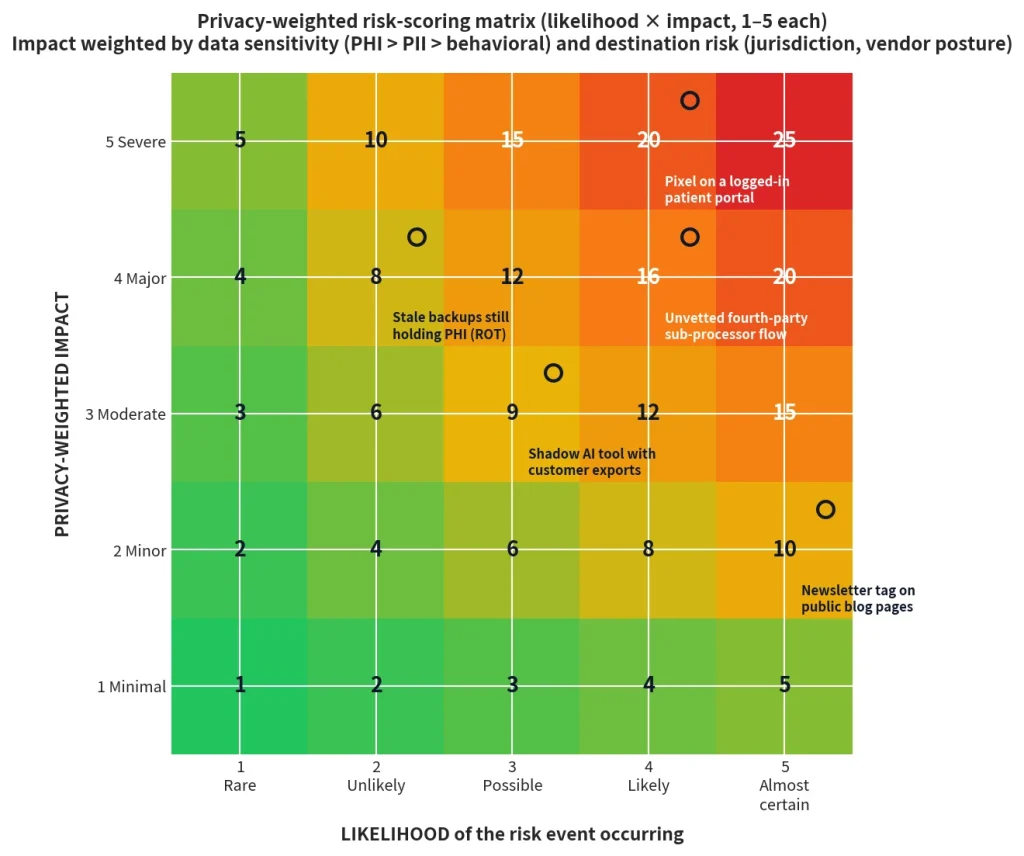
Figure: the privacy-weighted scoring matrix. Example placements are illustrative; your scores come from your own flow map. Data minimization (collecting less in the first place) lowers both axes at the source.
Impact by cost channel
The 5×5 matrix condenses impact into a single number. A fuller scoring decomposes impact into the four cost channels from the costs section, then applies a sensitivity multiplier:
Privacy Risk Score = Likelihood × (Regulatory + Litigation + Contractual + Reputational) × Sensitivity
Likelihood (1–5) here asks how certain the exposure is, not how likely it is to happen: 1 is theoretical, 5 is observed and continuous. Findings scored from real observation tend to land at 4 or 5, which is the practical advantage of assessing from traffic rather than documents. Likelihood stops being a guess.
Rate each impact area from 1 to 5 and add them up. A score of 1 means there’s no obligation, or any obligation is clearly met. A 3 means there’s a clear obligation with moderate risk. A 5 means a direct violation in an area where enforcement or lawsuits are happening.
The sensitivity multiplier is 1.0 for regular personal data, 1.5 for sensitive personal data, and 2.0 for health, payment, or biometric data where people can sue directly. Final scores range from 4 (the minimum, since each area scores at least 1) up to 200: 4–40 is low, 41–90 is moderate, 91–140 is high, and 141–200 is critical.
Worked example (illustrative). An observation on a healthcare provider’s appointment page shows a hashed email address and a specialty path in the URL flowing to an analytics vendor that appears in neither inventory nor disclosure. The transfers continue after the visitor rejects non-essential cookies.
| Input | Score | Reasoning |
| Likelihood | 5 | Observed on every page load, in both consent states |
| Regulatory | 4 | PHI to a party with no business associate agreement |
| Litigation | 5 | Healthcare tracking; statutory damages available, active filings |
| Contractual | 3 | Payer agreements carry notification obligations |
| Reputational | 4 | Patient data; mainstream coverage likely |
| Sensitivity | ×2.0 | PHI |
5 × (4 + 5 + 3 + 4) × 2.0 = 160: critical. The same page with a disclosed, contracted vendor and honored consent scores roughly 30: low. Identical likelihood; the difference is driven entirely by recipient status, data sensitivity, and consent state.
Likelihood scoring is only as good as your visibility. Score a finding “1, theoretical” when the real answer is “5, happening continuously, we have just never looked,” and the arithmetic comes out clean and wrong.
One scale note. Neither 5×5 nor the cost channel formula is the only rendering; they are manual conventions, and the underlying dimensions are what matter. Melurna scores the same dimensions from observed flows, data sensitivity, and destination risk, and reports them as A–F decision-friendly grades. The logic is identical; the alphabet differs.
Step 4: Map the obligations.
For each scored flow, identify which legal instruments apply: GDPR (including whether a Data Protection Impact Assessment is mandated), CCPA/CPRA (including sensitive personal information limits, contract and opt-out requirements), HIPAA, or sector rules.
This step links your assessment to real evidence. If a regulator asks why a data flow was allowed, you can point to this mapping, with a date. Melurna’s compliance monitoring matches what vendors actually do to these legal frameworks, so your mapping always reflects your current setup.
Step 5: Prioritize and assign owners.
Rank risk events by score. Each gets a named owner and a decision: accept, monitor, or route to treatment.
Step 6: Report to leadership and set the re-assessment cadence.
Boards need a short, recurring report on top exposure areas by privacy-weighted score, status of regulatory obligations, current litigation and enforcement exposure, assessment cadence, and progress on open findings, tracked as a trend, not a one-time snapshot.
Assessments can quickly become outdated as scripts change, vendors add new sub-processors, and new AI features appear between audits. It’s better to check regularly than to do one big review. Continuous monitoring lets you always see the current status and trends, instead of having to piece things together every quarter.
Data privacy best practices
Treatment starts where assessment ends, and the levers are few enough to name here:
- Collect less (data minimization).
- Collect lawfully (consent architecture that actually gates tags before they fire).
- Keep data only as long as it is needed (retention limits and secure disposal).
- Bind recipients contractually (processor terms, sub-processor clauses, audit rights).
- Train the people who handle data and AI tools.
- Re-audit high-risk processing on a cadence: profiling, sensitive categories, automated decisioning.
Read the complete article about how to reduce data privacy risk for detailed execution.
Common misconceptions about data privacy risk
Most organizations don’t invest enough in privacy risk because of a few common but misleading beliefs.
| # | Assumed | Actual |
| 1 | “We’re compliant, so we’re safe.” | Paper compliance drifts; regulators test mechanisms, not documents |
| 2 | “No breach means no risk.” | The risk event can be the processing itself – no attacker required |
| 3 | “Our vendors’ contracts cover us.” | Contracts record promises, not flows; fourth parties sit outside them |
| 4 | “Privacy risk is IT’s problem.” | Marketing, HR, product, and legal all create and own privacy risk |
| 5 | “We’re too small to be a target.” | Regulators fine small practices; demand letters don’t check headcount |
| 6 | “‘Anonymized’ data can’t be re-identified.” | Hashing and de-identification are often reversible; linkage attacks succeed routinely |
1. “We’re compliant, so we’re safe.”
Tractor Supply had privacy policies and a cookie tool, and the CPPA’s $1.35 million decision found the policy deficient, the opt-out mechanism ineffective, and the vendor contracts missing required terms. Compliance is a state of mechanisms, not a shelf of documents, which is why assessment runs on a cadence.
2. “No breach means no risk.”
Statute says otherwise: CIPA damages require no actual harm at all, and NIST’s privacy risk model catalogs privacy harms that arise without any unauthorized access. Healthline, GM, and TikTok were not breached; they were processing.
3. “Our vendors’ contracts cover us.”
Contracts shift cost after the fact. They do not see the wire. Honda was fined in part for sharing data with ad-tech companies without the required contract terms: the agreement-driven model failing exactly where it was supposed to protect. Your fourth parties have no contract with you at all.
4. “Privacy risk is IT’s problem.”
Marketing deploys the pixels. HR deploys the biometric time clocks and the shadow-AI tools. The product embeds the AI endpoints. Legal owns the obligations. The Ponemon data on negligent insiders (ordinary employees making ordinary mistakes) is the statistical signature of an organization-wide risk, not a server-room one.
5. “We’re too small to be a target.”
HHS OCR’s enforcement docket is not only headline cases. It includes a $70,000 penalty against a dental practice, a $100,000 penalty against a mental-health center, and five-figure settlements with small providers. And the tracker-litigation wave works from scanned website lists, not revenue rankings.
6. “‘Anonymized’ data can’t be re-identified.”
NIST’s risk model catalogs the “re-identification of information linked to a specific individual, notwithstanding representations that a participant’s information would be anonymous or not identifiable” as a canonical privacy risk.
Demonstrations keep proving the point: The Markup reversed most of the hashed personal details it observed flowing to Facebook, using a free online tool. Treat “anonymized” as a claim to be tested, not a property to be assumed.
Who owns the privacy risk?
In most organizations, no single team owns privacy risk. Marketing adds tracking tags, security manages the perimeter, legal writes the policies, procurement handles onboarding, and engineering builds the data pipelines.
Each department owns part of the process, but no one is responsible for the whole data transfer. For example, if marketing adds a tag that sends data to a vendor chosen by procurement, under a policy from legal, using a pipeline built by engineering, it’s hard to say who should have caught a problem. With so many possible answers, often no one takes full responsibility.
What matters isn’t which function you pick. It’s that someone is explicitly accountable for where our data actually go, with both the technical means to find out and the standing to act on the answer. If that accountability isn’t written down somewhere, it doesn’t exist.
FAQs
Is privacy risk the same as security risk?
No. Security risk concerns unauthorized access to data; privacy risk concerns whether the intended, authorized use is legitimate. An organization can have excellent security and severe privacy exposure because the controls that stop intruders say nothing about whether an approved data flow should exist. A system can be perfectly secure and still fail to protect personal data from misuse.
Can privacy risk exist without a data breach?
Yes, and the more expensive events increasingly involve no breach at all. Undisclosed sharing, consent that is recorded but never enforced, and purpose drift all create exposure, even when every system works as designed.
What is a data privacy risk assessment?
A structured method (DPIA/PIA-class) to map data flows, identify risk events, score likelihood and impact, map legal obligations, and prioritize treatment, repeated on a cadence, not once.
When is a DPIA required?
When processing is likely to result in a high risk to individuals’ rights and freedoms, under GDPR Article 35 and equivalent provisions. The trigger is the risk threshold, not a schedule, so new processing that meets it requires one regardless of when the last assessment ran.
What is fourth-party risk?
Exposure created by parties your vendors share data with – subprocessors and downstream services you have no contract with and often no record of. It matters because accountability for personal data follows the data, not the contract, and questionnaires only reach one hop out.
What are the most common data privacy risks?
Unauthorized third-party tracking, hidden fourth-party vendor flows, overcollection without valid consent, shadow AI tools, insider misuse, overprivileged access, misconfiguration, stale retained data, cross-border transfers, and compliance drift.
How do third parties create privacy risks?
Vendors, pixels, SDKs, and embedded AI endpoints receive your users’ sensitive information and often share it onward to fourth parties you never vetted, creating regulatory and litigation exposure your contracts may not reflect. Regulators treat the collector as accountable for downstream recipients, as the GM and DoorDash settlements show.
DISCLAIMER: This guide is for general informational purposes only and does not constitute legal advice. While we strive for accuracy, we make no warranties about the completeness or reliability of this information, and are not liable for any errors, omissions, or actions taken based on its contents. Consult a licensed attorney for guidance specific to your business.