
Meta Pixel wiretapping is the claim that a standard advertising pixel on a website intercepts a visitor’s communications with that site as they happen and transmits them to Meta without the visitor’s consent. Plaintiffs argue this violates federal and state wiretapping statutes. The defendant in these cases is usually not Meta. It is the website operator, the business that installed the pixel and, in the plaintiff’s telling, caused the interception.
The Meta Pixel itself is legal, and millions of sites run it. The legal risk often turns on when the pixel activates in relation to user consent, especially whether it fires before a user has agreed to tracking. For website operators, marketing leaders, and the legal advisors who oversee Meta Pixel deployments, that timing issue can create significant legal and financial exposure if visitor data is sent before consent. Plaintiffs can often detect this more easily than site owners, since their tools monitor actual network traffic, while a consent dashboard only shows what is supposed to happen.
Key takeaways
- Meta Pixel wiretapping is a claim about when the pixel fires and what it sends. The tool itself is legal.
- The defendant is the website operator, not Meta. The statutory stack is CIPA § 631 and § 638.51, the federal Wiretap Act, and the VPPA where video exists.
- Courts have repeatedly allowed the theory to survive, one jury has returned a verdict, and certification has also failed. Both forks are real.
- Exposure arithmetic starts at $5,000 per violation. Verified settlement anchors run from $1.5M to over $12M.
- The four failure patterns (pre-banner, pre-click, GPC-ignored, broken Reject-All) generate nearly every demand letter, and you can test for all four today.
- A one-time scan is a snapshot. Continuous client-side observation is the only posture that matches how plaintiff scans work.
If you are evaluating pixel tracking risk, this guide explains the claim itself, the wiretapping laws plaintiffs invoke, current court positions as of August 2026, potential financial exposure, how plaintiffs detect pixel tracking, the consent failure patterns that trigger claims, how to check and remediate your own implementation, and what to do if you have already received a demand letter. It will help you understand where Meta Pixel wiretapping risk usually comes from and what to fix first.
What is Meta Pixel wiretapping?
Meta Pixel wiretapping is the claim that a website’s Meta Pixel violates wiretapping laws by reading the contents of a visitor’s interaction with the site and transmitting a copy to Meta in real time, before the visitor has consented. The theory targets timing and transmission, not the tool itself: the pixel is a lawful, widely used piece of Meta code.
The Meta Pixel is a JavaScript code that Meta provides to help businesses track ad performance. It sends data such as page views, searches, cart actions, and purchases back to Meta to help optimize campaigns and build audiences. What matters legally is that it collects this data directly from your page, while visitors are interacting with your site.
What the Meta Pixel actually transmits
Court records in the pixel cases (the pleadings and orders in the healthcare and tax-filing litigation, cited in the posture table below) describe a consistent transmission inventory:
| What the pixel sends | What it reveals | Why it matters legally |
| Full page URL | Which page the visitor is on, and on many sites what they searched for or asked (descriptive URLs, query strings) | A court has held that descriptive page URLs can be the “contents” of a communication: the thing wiretap law protects most |
| Referrer URL | Where the visitor came from | Can carry search terms and campaign context the visitor never gave you |
| IP address | Visitor’s location and network identity | Routing data: the basis for pen-register claims where the contents theory fails |
| fbp / fbc cookies | Meta’s browser and click identifiers | Let Meta map “anonymous” browsing on your site to a specific Facebook profile |
| Standard events (PageView, ViewContent, Search, AddToCart, InitiateCheckout, Purchase) | What the visitor did, in sequence, as they did it | The real-time behavioral stream plaintiffs characterize as interception |
| Event parameters (items, prices, cart value) | What the visitor intended to buy or asked about | On health, tax, or finance pages, this is where sensitive facts leak |
| Advanced Matching fields (hashed email, phone, name, date of birth, ZIP) | Who the visitor is, even before they log in | Turns “tracking” into identified transmission of personal information |
| Form data (when misconfigured) | Whatever the visitor typed: symptoms, income, account numbers | The worst case, and the one demand letters quote verbatim |
The URL row is why health systems and tax-preparation sites got sued first: a URL like /appointments/oncology or a query string containing a medical question is not metadata. It is the content of the visitor’s communication with the site. (The generic mechanics of how client-side scripts leak data this way are covered in our data-leakage explainer; this page stays on the Meta Pixel specifically.)
How the Meta Pixel tracking tool becomes a “wiretap”
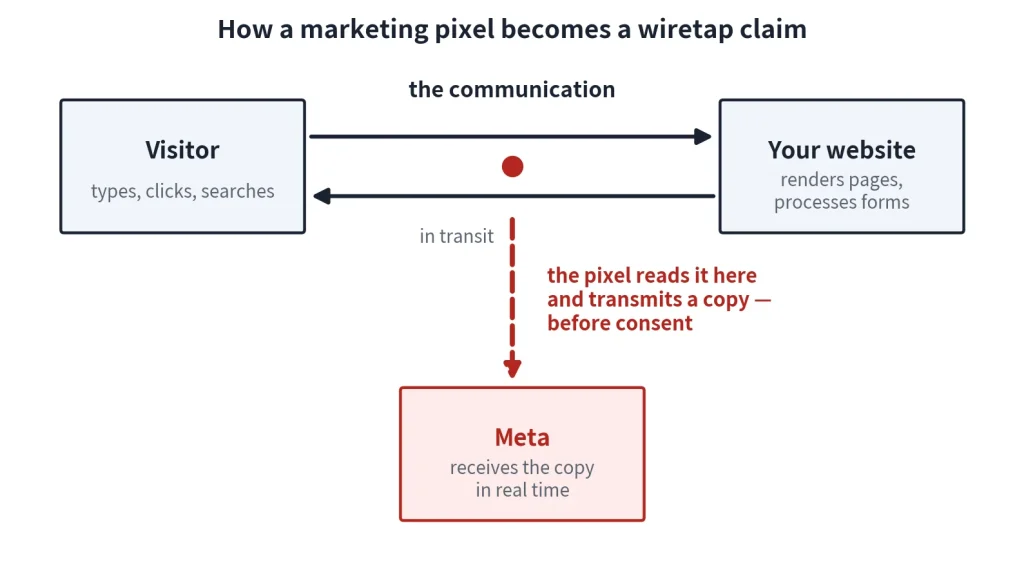
The wiretap theory is a three-party model, and it maps almost mechanically onto statutes written for telephone taps:
- The visitor interacts with your website: loading pages, entering search queries, submitting forms. That is a two-party communication, and both parties consent to it.
- The pixel is Meta’s code that executes on your page. It reads that communication as it happens: the URL, the events, the identifiers.
- It sends a copy to Meta in real time, even before the visitor has given their consent for Meta to receive anything.
The entire claim is that a third party is reading the contents of a communication between two other parties while the communication is in transit. Wiretap statutes were written for someone tapping a phone line mid-conversation. Plaintiffs say the pixel acts like that tap.
Similar risks can arise outside websites too, including in marketing email tracking, and email pixels have also drawn claims under Arizona’s Telephone and Utility Service Records Act.
Why the claim lands on you, not Meta?
The reason why demand letters are aimed at the website operators is that it was they who installed the pixel and who decided when it would become active. The state of California’s wiretap law holds not just the person who carries out the interception responsible, but also anyone who assists in or agrees to it; this is the reason why the plaintiffs claim that a business which adds Meta’s code to its checkout page is to be held responsible.
Whether courts will fully accept this idea is still being debated, but the reason you get the letter is structural, not accidental.
Which wiretapping laws does a Meta Pixel trigger?
The wiretapping arguments put forward by Meta Pixel are based on four laws: California’s Invasion of Privacy Act (CIPA), in both its wiretap and pen register forms, the federal Wiretap Act, and the Video Privacy Protection Act in the case of sites that have video coverage. Additional provisions come from other state laws requiring all-party consent.
The statute stack
| Statute | What it prohibits | Damages | When it bites a pixel site |
| CIPA § 631(a), California wiretap law | Willfully reading or learning the contents of a communication “while the same is in transit,” without the consent of all parties, including anyone who aids or procures it | Greater of $5,000 per violation or 3× actual damages (§ 637.2); no proof of actual damages required | Pixel reads URLs, form entries, or event data while the visitor is mid-interaction with your site, before consent |
| CIPA § 638.51, pen register / trap and trace | Installing or using a device that captures routing/addressing information (the who-and-where, not the contents) without a court order | Same § 637.2 damages | Pixel captures IPs and identifiers even where a “contents” theory fails: a federal court held in 2025 that software trackers can qualify as pen registers. Depth and case scoreboard: What are pen registers |
| Federal Wiretap Act / ECPA, 18 U.S.C. § 2511 | Intentional interception of electronic communications | Statutory damages plus criminal exposure | Pleaded alongside CIPA; federal law allows one-party consent, which is why the stricter all-party state statutes do the work in these cases |
| VPPA, 18 U.S.C. § 2710 | A video provider knowingly disclosing information tying an identified consumer to specific video materials, without informed written consent | Liquidated damages of not less than $2,500 per person; 2-year limitations period | Pixel + embedded video: the pixel tells Meta which Facebook user watched which video. See the dedicated section below |
| Other all-party state statutes | Variants of the same interception rule in roughly a dozen states | Varies; several have statutory damages | Visitors from those states plead their home statute; note that readings diverge sharply: Massachusetts’ high court rejected the theory in 2024 (posture table below) |
The full statute map, amendment history, and exposure math live in our CIPA guide. The table above is what you need to read a Meta Pixel demand letter.
If your site has video: the Video Privacy Protection Act (VPPA) exposure
The Video Privacy Protection Act is a 1988 statute, written after a newspaper published a Supreme Court nominee’s video-rental history. It describes a Meta Pixel on a video page with uncomfortable precision. If your site shows video and the pixel sends an identifier which Meta can use to link to a Facebook account together with the identity of the video that was watched, then you have disclosed precisely what the VPPA was meant to protect – that is, who watched what. The central issue is often whether the transmission included personally identifiable information under the statute. Litigation also expanded beyond wiretap theories, and in recent years dozens of class action lawsuits were filed over Pixel use on video pages.
This is not theoretical. In Ambrose v. Boston Globe Media Partners (D. Mass.), the Boston Globe settled VPPA claims over its pixel for a $4 million cash fund plus up to $1 million in in-kind relief, with final approval after the September 7, 2023 hearing. The settlement’s injunctive term required the Globe to suspend the pixel on pages with video and identifying URLs until it had VPPA-compliant consent.
Two cautions before you over- or under-react
The issue of who is considered a VPPA “consumer” is currently divided among the courts. In its 2025 ruling inSalazar v. Paramount Global, the Sixth Circuit interpreted the “subscriber” requirement in a restrictive manner and the Supreme Court then agreed to hear the case (No. 25-459). The question of the scope is indeed still open.
Second, having a video on the homepage does not amount to the same thing as having access through a logged-in video library. The issue in a Meta Pixel case under the VPPA is the transmission of personally identifiable information tied to specific video materials. If video content is important to your business, then regard VPPA as a separate workstream and consult a privacy attorney on it.
Why the vendor defense fails for Meta
The natural procurement reflex is: “We signed a DPA, same as our other vendors. The pixel is Meta’s tool, so if anyone intercepted, it’s Meta’s problem.” For most tracking vendors, that instinct has a real doctrinal basis. For Meta, it is structurally unavailable.
The defense is the party exception: a wiretap requires a third party eavesdropping on two communicants. If the tracking vendor is merely your agent (a “tape recorder” acting only on your behalf), then no third party exists, and there is no interception.
In Graham v. Noom (N.D. Cal. 2021), the court held this defense turns on a specific fact: whether the vendor is contractually barred from using the collected data for its own independent purposes. A vendor that can only process data for you is arguably your tape recorder.
Meta fails that test by design. Pixel data feeds Meta’s own advertising business (audience building, ad optimization, its own products), and Meta’s terms do not bar that independent use.
In the healthcare and tax-filing MDLs, Meta’s own use of the data is not a side detail. It is central to why the claims survive. (This is also the honest contrast with a pure analytics vendor: the tape-recorder argument is at least arguable for a tool that only processes data on your behalf, which is why Google Analytics comparisons go differently.) No DPA you sign fixes this, because the problem is Meta’s own business model, not your paperwork.
Does complying with the California Consumer Privacy Act (CCPA) protect you?
No, the California Consumer Privacy Act is a notice-and-opt-out statute regulating whether you tell consumers you “sell or share” their data and whether you honor opt-outs. CIPA is an interception statute with its own consent standard. A business can be fully CCPA-compliant and still intercept communications under § 631 every time the pixel fires before consent.
Different statute, different consent theory, different plaintiffs’ bar.
The timing rule is stricter than most teams assume. In Javier v. Assurance IQ (9th Cir. 2022), the Ninth Circuit held that CIPA consent must be prior: consent obtained after interception begins does not cure it.
A banner that renders while the pixel is already firing is not explicit consent. It records the violation with the visitor watching.
Where the courts stand on Meta Pixel wiretapping (2026 posture)
The law is unsettled but not unknowable: wiretap and pen-register claims have survived dismissal against Meta and against website operators, one jury has returned a CIPA verdict against Meta, and class certification has also failed on standing grounds. Both forks are real, and which one your case resembles depends on facts about your own implementation.
| Case | Court | Date | Holding | What it means for operators |
| In re Meta Pixel Healthcare Litigation (MDL) | N.D. Cal. (Orrick, J.) | Sept 2023; Jan 29, 2024 | Motions to dismiss denied in part: ECPA, CIPA § 631, contract, and unjust enrichment claims survived; later order let intrusion-upon-seclusion, CDAFA, and trespass claims proceed. (Dec 2023: preliminary injunction denied, the court citing Meta’s filtering of health data.) | The wiretap theory survives the pleadings against Meta over patient-portal data, and the same theory is pleaded against the hospitals |
| In re Meta Pixel Tax Filing Cases | N.D. Cal. (Pitts, J.) | Aug 2025; Mar 30, 2026 | § 638.51 pen-register dismissal denied: Meta “uses” the Pixel, rejecting the contents-only loophole. Then: class certification denied: no named plaintiff’s tax data found in Meta’s systems, the broadened class collided with CIPA’s 1-year limitations period, and predominance failed | Meta escaped the class, not the theory. Individual and mass-arbitration claims remain fully available |
| Frasco v. Flo Health, Inc. | N.D. Cal. (Donato, J.) | Aug 1, 2025 | Jury verdict: Meta liable under CIPA for intentional eavesdropping/recording without all-party consent, the first CIPA jury verdict against Meta. Flo, Google, and Flurry settled (final approval hearing for those settlements set for Oct 29, 2026); Meta alone faced the jury | This was an SDK/mobile-app case, not the website Meta Pixel, but it proves the theory can survive a jury, which changes every settlement negotiation |
| St. Aubin v. Carbon Health Technologies | N.D. Cal. | Oct 1, 2024 | Descriptive page URLs can be communication “contents” under § 631 | Your URL structure alone can carry the contents theory |
| Torres v. Prudential (docket later captioned Hazel) | N.D. Cal. | Apr 17, 2025 | A session-replay tool was not read “in transit,” a narrowing reading of § 631; plaintiffs appealed to the Ninth Circuit (No. 25-3203) | The in-transit requirement has real teeth for the defense in some configurations |
| Camplisson v. Adidas America | S.D. Cal. | Nov 18, 2025 | Software trackers can qualify as “pen registers” under § 638.51 | The pen-register theory does not need contents at all |
| Blaker v. NetScout | L.A. Superior | May 2026 | §§ 638.50–.51 pen-register provisions are telephone-only | State-court split with Camplisson: the pen-register question remains unresolved |
| Wiley v. Universal Music Group | N.D. Cal. | Dec 17, 2025 | Broken-banner claims partly survive dismissal: pixel allegedly fired despite the user clicking “Reject All” | A consent banner that doesn’t actually block is evidence for the plaintiff, not a defense |
| Gassman v. Guardian Credit Union | E.D. Wis. | Mar 31, 2026 | Nine claims survive dismissal; “the data was anonymized and disclosed in our privacy policy” held to be a fact dispute, not a dismissal ground | Anonymization and policy disclosures will not get you out at the pleading stage |
| Vita v. New England Baptist Hospital | Mass. Supreme Judicial Court | Oct 24, 2024 | Pixel page-view tracking is not “interception” under the Massachusetts wiretap statute | Defense-favorable and Massachusetts-specific. It shows state statutes diverge, not that the theory is dead |
| Popa v. Microsoft Corp. | 9th Cir. | Aug 26, 2025 | Article III standing bars pixel-tracking claims absent concrete harm | The federal-court off-ramp: one reason plaintiffs file in California state court |
No court has endorsed the pixel wiretap theory wholesale, and no court has killed it. What the record shows is a theory that keeps surviving motions, produces settlements, and just produced a jury verdict, alongside genuine defense wins on standing, statutory scope, and certification. That is a risk profile to be measured against your implementation.
Who gets targeted, and how plaintiffs find you
Plaintiffs do not visit your website. Their scanners do. The scan that finds your pixel firing before consent is also the exhibit in the demand letter that follows.
The scan is the plaintiff
The pipeline is mechanical. Tooling used by plaintiff firms loads your page the way a first-time visitor would, records the network traffic, and checks whether requests to Meta’s servers fire before any consent interaction, and whether they fire at all for users sending opt-out signals. Plaintiffs’ attorneys now use repeatable scan-and-demand workflows to identify sites where the pixel fires before consent. If they do, the capture goes into a demand letter as Exhibit A. The evidence against you is your own network log, timestamped, recorded by someone else. The scanner does not read your banner configuration, it reads what actually fired.
The industries getting letters
Any site with a pixel and California visitors is reachable, but the filings cluster where the transmitted data is sensitive or identity-rich, and companies across these sectors are being targeted when using Meta Pixel on sensitive or identity-rich journeys:
| Industry | Why exposed | Typical trigger data |
|---|---|---|
| E-commerce | Checkout and cart events tie an identified person to purchase intent; high visitor volume | Product URLs, cart contents, InitiateCheckout / Purchase events |
| Media & publishing | Video pages + logged-in readers = VPPA pairing on top of CIPA | Video titles alongside fbc identifiers |
| Healthcare | Patient portals, symptom searches, descriptive URLs; the MDL epicenter (HIPAA-adjacent rules add a second layer; see our healthcare tracking guide) | Appointment paths, condition pages, portal URLs |
| Tax & financial services | The tax-filing MDL made this a named category; form fields carry income and account data | Filing-status events, form entries, loan/application pages |
| SaaS | Authenticated app pages and account flows sit behind the marketing site, often with the same pixel, including sharing with third-party vendors | Account-page URLs, in-app events, signup form data |
What the Meta pixel wiretap exposure looks like in dollars
The arithmetic is $5,000 per violation, per visitor, per transmission. The settlement market that arithmetic has produced now runs from seven figures to eight.
CIPA’s private right of action (§ 637.2) awards the greater of $5,000 per violation or three times actual damages, with no requirement to prove actual harm. Plaintiffs plead each non-consensual transmission for each visitor as a violation, so the demand-letter math is a multiplication of your traffic. A site with 100,000 California visitors a month is looking at a pleaded nine-figure number, which is the point: the figure is designed to make any settlement demand look reasonable.
What actual resolutions have looked like:
| Case | Year | Amount | Theory |
| Advocate Aurora Health (E.D. Wis.) | 2023–24 | $12,225,000 non-reversionary fund; preliminary approval Aug 2023, final approval July 2024 | Healthcare pixel: CIPA / ECPA / state claims |
| Markels v. AARP (N.D. Cal.) | 2026 | $12.5M fund; judgment entered Feb 20, 2026 | Pixel transmitting members’ video/page activity |
| Ambrose v. Boston Globe Media Partners (D. Mass.) | 2023 | $4M cash + up to $1M in-kind; pixel suspended on video pages pending compliant consent | VPPA |
| In re Novant Health, Inc. (M.D.N.C., No. 1:22-cv-00697) | 2024 | $6.6M fund; final approval granted June 2024 | Healthcare pixel |
| C.M. v. MarinHealth Medical Group (N.D. Cal.) | 2025 | Settlement; case dismissed Nov 25, 2025 (terms submitted to the court in camera) | Healthcare pixel |
| Atrium Health (Roberts v. Charlotte-Mecklenburg Hospital Authority) | 2026 | $1.8M; preliminary approval granted, final approval hearing set for Sept 30, 2026 | Healthcare pixel |
| FTC action against GoodRx | 2023 | $1.5M civil penalty; order bars sharing health data for advertising | First-ever Health Breach Notification Rule enforcement: regulator, not class action |
Demand-letter economics sit below these numbers: individual pre-suit resolutions are typically priced to be cheaper than a defense, which is what makes the scan-and-letter pipeline profitable at volume.
See what your pixel is actually sending →
How to detect pixel tracking across journeys
Run these in order, in a clean incognito window with no extensions:
- Inventory every pixel instance, not just the one in your tag manager. Check templates, plugins, app embeds, landing-page builders, and hard-coded snippets. Inventory any session replay software at the same time, because plaintiffs often scrutinize it under the same wiretapping-style claims. Demand letters regularly cite a second pixel the marketing team forgot existed.
- Run the network-tab test. Open developer tools → Network, filter for facebook, reload the page, and do not touch the consent banner. If you see requests to Meta before any consent interaction, that capture is what a scanner sees.
- Check your tag manager’s firing order. Verify the pixel’s trigger actually depends on a consent state, not just that a consent setting exists somewhere in the container.
- Search your source for hard-coded fbq. Template-level snippets bypass tag manager consent settings entirely.
- Test with Global Privacy Control enabled. Turn on GPC (a browser signal, legally effective as an opt-out under CCPA per the California AG) and reload. If the pixel still fires, you have a documented failure pattern.
- Review Advanced Matching. If it is on, the pixel may be sending hashed emails, phone numbers, or names from pages where visitors never logged in. Depending on the fields passed, event data can become personally identifiable information. Know which fields, on which pages.
- Map pixel events to sensitive pages. Checkout, login, health or finance forms, account pages: list exactly which events fire on each. This is the map plaintiffs build; you want yours first.
- Correlate logs to events before you panic. A loaded script is not a fired event. Cached requests and tag-manager previews create false positives. Confirm actual transmissions before treating a hit as exposure, and before declaring yourself clean.
(This is the Meta-Pixel-specific version of the five-step website self-check in our data-leakage explainer. The generic version covers the rest of your third-party stack.)
The four failure patterns demand letters are built on
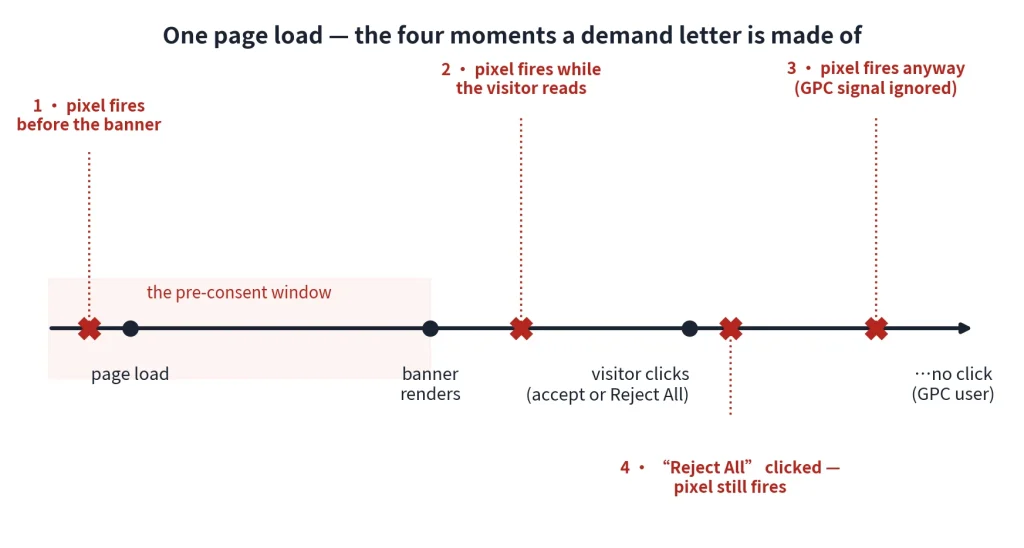
Nearly every Meta Pixel demand letter describes one of four configurations:
| Pattern | Root cause | Fix |
| Fires before the banner renders | Pixel loads in <head> ahead of the consent tool | Consent state must gate the pixel’s load, not just its events |
| Fires between banner render and user click | Banner displays but the pixel runs while the visitor reads | Default-deny until affirmative action: Javier requires prior consent, so the pre-click window is already a violation |
| Fires for GPC users | Consent tool ignores or never reads the Global Privacy Control signal | Honor GPC as an opt-out and test it like a visitor |
| “Reject All” doesn’t block | CMP category mapping is broken: the button exists, the blocking doesn’t (the Wiley pattern) | Click your own Reject All in incognito and watch the network tab |
What a defensible setup actually requires
A defensible setup is a consent architecture, not a banner. The spec below is what your consent tooling, whatever vendor you use, must actually achieve, verifiably, on every page where the pixel exists.
- Default-deny before load. The pixel does not load or fire until an affirmative opt-in. “Notice + continue browsing” does not meet the prior-consent standard.
- Sensitive-pages minimization. No pixel, or a strictly stripped event set, on checkout, authentication, health, and finance pages, per the events-to-pages map from the self-check.
- Advanced Matching off by default, enabled only field-by-field with a recorded justification.
- GPC honored, verified by test, not by vendor documentation.
- A living pixel inventory with data-flow maps: every instance, what it sends, where it fires, who owns it. Reviewed every release, because deployments change what fires.
- A privacy policy that names the Meta Pixel specifically and describes these flows accurately.
- Immutable consent logs: who consented, when, to what. If you ever have to prove prior consent, this log is the proof.
One thing we will tell you that consent-tool vendors won’t: gating the pixel costs you signal. Fewer events reaching Meta means weaker optimization and worse attribution, and that is a real cost, not a compliance talking point.
The right frame is a marketing-and-legal alignment decision (what fires where, with what justification) made deliberately, not a default nobody chose.
What your pixel is actually sending right now
The rise of pixel litigation has pushed many teams toward stricter consent management practices. Most teams believe their consent configuration. Almost none observe their actual transmission. The claims in the tables above were born in that gap.
Configuration is belief. Transmission is evidence. Your CMP dashboard tells you what should happen. The scanner that examined your site last month recorded what did happen. Those documents disagree, and the reason is structural: websites drift.
Every deploy, every plugin update, every new landing-page template, every third-party embed is an opportunity for the pixel’s behavior to change: a snippet reappears in a template, a chat widget loads its own tracker, a tag manager rule gets edited by someone fixing a conversion report.
The self-check you carried out today is like taking a snapshot of a constantly changing situation, since the plaintiffs are continuously rescanning and a single clean scan only provides coverage for one day.
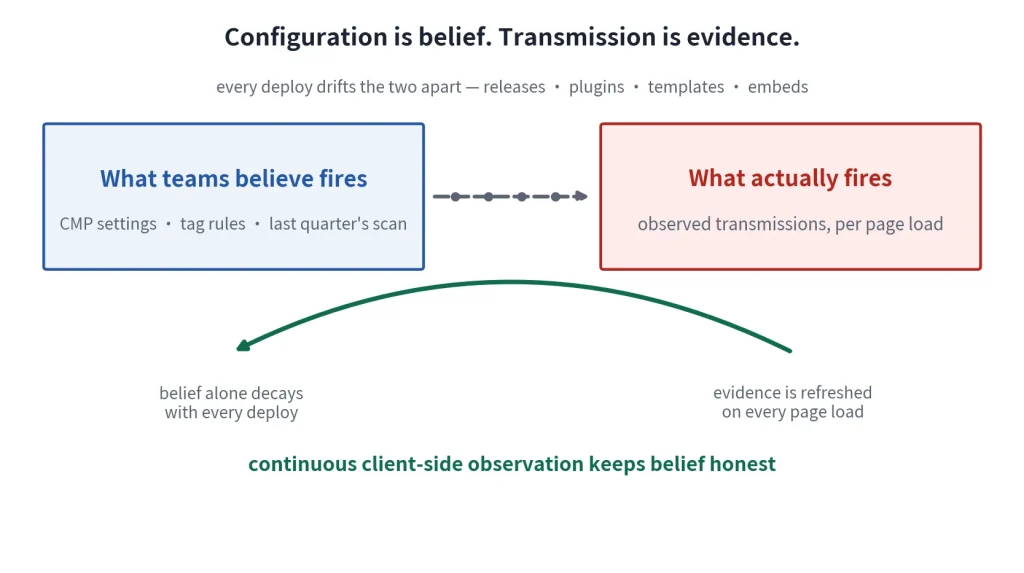
A worked example of what observation reveals that configuration cannot: your banner is correctly configured to gate the pixel. Observations show pixel firing between page load and banner render on your blog templates because a performance optimization moved the CMP script below the fold. Nobody misconfigured anything on purpose. A deploy changed the execution order. Your configuration says “compliant.” Your transmission record says “firing pre-consent on the blog templates since Tuesday’s release.” Only one of those documents is evidence.
How MELURNA watches this
When we run client-side observation on sites that believe they are gated, the findings concentrate in exactly the four failure patterns above. What is not knowable from public records, or from your CMP settings, is your own pixel’s behavior. That requires watching it continuously, the same way the other side does.
See what your pixel is actually sending →
If a demand letter arrives
Slow down, preserve everything, and change nothing yet. First, identify what you are actually holding: a demand letter is not a filed complaint: different instruments, different deadlines, and the right first move depends on which one it is. Then, in order:
- Preserve evidence before you change anything. Your network logs, tag-manager version history, CMP configuration, and banner code are evidence. Reconfiguring your stack the day the letter arrives can cause a spoliation problem that costs more than the underlying claim.
- Do not send a substantive response without counsel who has handled wiretap-claim demands and similar wiretapping cases specifically.
- Notify your cyber/privacy insurer. Early notice is often a policy condition, and these matters often arise under broader privacy laws.
- When remediation happens, document it. A dated, evidenced record of fixes materially reduces settlement pressure, because it shrinks the class period plaintiffs can plead.
The full response playbook, with sequencing and templates, is in our CIPA guide. For how these campaigns operate at scale, see the Shah campaign breakdown.
Next steps
Run the self-check above. It takes an afternoon and tells you which failure patterns apply to you. Then close the gap a check cannot: configurations drift with every deploy, so the durable answer is continuous observation of what your pixel actually transmits.
Start a Melurna assessment: see what your pixel is actually sending →
FAQ
Does cyber insurance cover pixel wiretapping claims?
Sometimes. Pixel claims are often tendered under privacy or media liability coverage, and outcomes vary by policy language. The key point is timing: notify your insurer as soon as a demand letter arrives because late notice is a common denial ground.
What is the statute of limitations?
For CIPA claims, one year, short enough that it decided the class-certification outcome in the tax-filing MDL, where the broadened class collided with the limitations period. The VPPA allows two years. Which clock applies, and from when, is a counsel question. Do not assume the short window makes old conduct safe, since plaintiffs argue the firing is ongoing.
Is Google Analytics “wiretapping” too?
The same theory is pleaded against other trackers, and the wave includes session-replay and chat tools. What differs is the vendor defense: a pure analytics vendor that only processes data on your behalf can at least argue the tape-recorder exception from Graham v. Noom. Meta cannot, because it uses pixel data for its own advertising business (see the vendor-defense section above).
Are tracking pixels illegal?
Tracking pixels are not inherently illegal, but using them without proper user consent, disclosure, or in sensitive sectors like healthcare can violate privacy and wiretapping laws.
DISCLAIMER: This guide is for general informational purposes only and does not constitute legal advice. While we strive for accuracy, we make no warranties about the completeness or reliability of this information, and are not liable for any errors, omissions, or actions taken based on its contents. Consult a licensed attorney for guidance specific to your business.