
A data risk management framework (DRMF) is a structured, repeatable system that helps organizations identify, assess, address, and monitor risks related to their data wherever it is created, stored, used, shared, archived, or deleted.
Verizon’s 2026 Data Breach Investigations Report found that third parties were involved in 48% of data breaches, a 60% jump in one year. Still, most data risk frameworks focus on databases, file storage, and cloud services, often missing the browser where third-party scripts can access customer data.
Key takeaways
- A data risk management framework is the repeatable machinery (inventory, assessment, controls, monitoring), not a policy document.
- No universal mandate exists, but HIPAA, GLBA, NYDFS Part 500, GDPR, and state written security program laws (WISPs) each require framework-shaped pieces. Everyone else answers to breach economics and customer trust.
- The standards answer different questions. Pick by regulatory driver, scope, and whether the board wants heat maps or dollars.
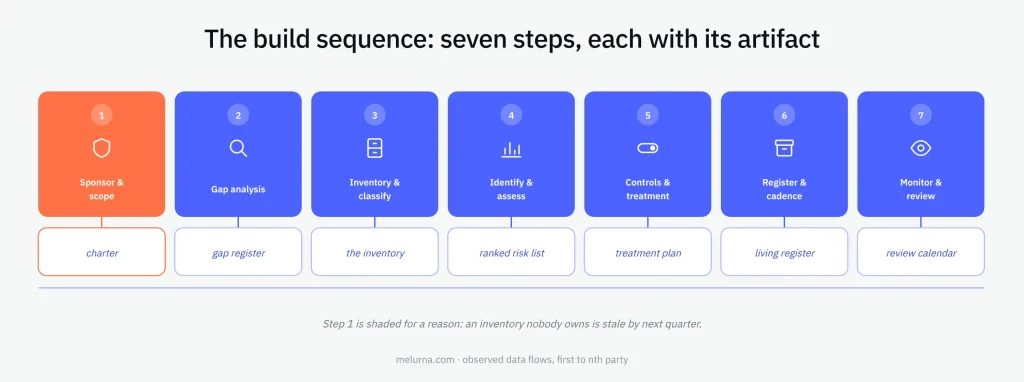
- Build in sequence: sponsor first, inventory third, and name an output artifact per step.
- The inventory is the load-bearing component, and the website layer is the part standard discovery tools never scan.
- Verify, don’t attest: claims and certificates are weaker evidence than watching the control operate.
This guide is for DPOs, privacy counsel, GRC leads, and security teams who need to build a framework, including the parts that are often overlooked.
What is a data risk management framework?
A data risk management framework is an organized system of governance, processes, controls, and monitoring that lets an organization identify its data risks, decide which ones matter, address them, and track them over time.
It is not just a policy document or a one-time assessment. Managing data risks continues even after the policy is signed.
Three related areas are often confused with a data risk management framework, and this confusion affects what organizations actually build:
| Term | What it actually is | Relationship to a DRMF |
| Data risk | The exposure itself: the potential for data to be breached, lost, corrupted, misused, or mishandled | The thing the framework manages |
| Data security | The tactical control layer: encryption, access controls, firewalls | One component of the framework’s treatment step |
| Data governance | Ownership, classification policy, and data-quality rules | The framework’s foundation: you cannot risk-assess data nobody owns |
| Enterprise risk management (ERM) | The organization-wide risk program covering financial, operational, strategic, and other risk classes | The DRMF plugs into it as the data-specific discipline |
Two properties separate effective data risk management from ad-hoc security work.
- It is repeatable: the same method is used each cycle, so results are comparable over time.
- It is connected: inventory feeds assessment, assessment guides controls, controls are monitored, and monitoring leads to the next assessment. If any link is missing, you have activities, not a true framework.
Which laws and regulators expect a data risk framework?
Most data protection regulations do not require a named framework like NIST or ISO 27001. They regulate the work behind one: identifying risk, applying safeguards, testing if they work, and reassessing as risks change.
| Regime | Who it applies to | What it requires |
| HIPAA Security Rule, 45 CFR § 164.308 | Covered entities and business associates | An accurate and thorough risk analysis of ePHI, measures to reduce identified risks, and periodic evaluation. |
| FTC Safeguards Rule, 16 CFR § 314.4 | Financial institutions subject to the FTC Safeguards Rule | A written risk assessment, risk-based safeguards, testing or monitoring, and regular written reporting to the board or equivalent governing body. Some requirements are exempted for institutions with customer information on fewer than 5,000 consumers under § 314.6. |
| NYDFS Cybersecurity Regulation, 23 NYCRR Part 500 | Entities covered by New York DFS Part 500 | A documented risk assessment that informs the cybersecurity program and is updated at least annually and when a business or technology change materially changes cyber risk. |
| GDPR, Articles 32 and 35 | Controllers and processors under Article 32; controllers for DPIAs under Article 35 | Security measures appropriate to risk, regular testing of their effectiveness, and a DPIA before processing likely to result in high risk. |
| California CCPA risk-assessment regulations | CCPA businesses conducting processing that presents significant risk to consumers’ privacy | Risk assessments for specified activities, including selling or sharing personal information, processing sensitive personal information, and certain automated processing. New covered processing must be assessed before it begins; covered processing already underway before January 1, 2026 must be assessed by December 31, 2027. |
| Massachusetts 201 CMR 17.00 | Persons that own or license personal information about Massachusetts residents | A written information security program that identifies foreseeable risks, evaluates safeguards, monitors effectiveness, and reviews security measures at least annually. |
The financial case runs alongside the regulatory one. IBM’s 2026 Cost of a Data Breach Report puts the global average breach cost at $4.99 million, up 12% year over year and a record high.
Regulators also treat risk analysis as foundational. In a March 2025 HIPAA enforcement action, OCR said an accurate and thorough risk analysis is required and is “the first step” in preventing or mitigating breaches of ePHI.
The enforcement posture is blunt about where regulators place risk analysis. Settling OCR’s fifth Risk Analysis Initiative action in March 2025, Acting Director Anthony Archeval said:
“Conducting an accurate and thorough risk analysis is not only required but is also the first step to prevent or mitigate breaches of electronic protected health information.”
In that case, OCR found that Health Fitness had failed to conduct an accurate and thorough risk analysis until January 2024, and the resulting corrective action plan required annual risk-analysis reviews and a risk-management plan.
What are the most common data risks a framework has to cover?
Data risks cluster into five groups, each with a different mechanism and a different control class:
- External attack. Phishing, credential theft, vulnerability exploitation, ransomware. The 2026 DBIR marks a shift: vulnerability exploitation became the leading initial-access vector at 31% of breaches, overtaking credential abuse (13%) for the first time in the report’s 19-year run.
- Insider threats. Malicious, careless, or compromised insiders. The human element is present in roughly 62% of breaches: the narrower figure behind the unsourced “95% of breaches are human error” claim circulating in vendor blogs.
- Third-party exposure. Vendors, partners, SaaS platforms, integrations. Third-party involvement reached 48% of breaches in the 2026 DBIR, up 60% year over year, the fastest-growing category in the report. (Privacy-specific vendor risk, including the browser-delivered vendor class, is its own discipline: third-party privacy risk management.)
- Operational failure. Accidental deletion, data corruption, bad backups, poor data quality. No attacker required; the damage is the same.
- Compliance exposure. Handling data in ways that violate a binding regime (unlawful processing, blown retention limits, missed notification clocks) even when no breach occurs.
What are the core components of a data risk management framework?
Every credible DRMF has the same key components, in the order a risk moves through it:
| Component | Function | What “done” looks like |
| Governance & ownership | A named accountable owner, risk appetite, policy authority | One person can be paged when a data risk materializes |
| Data inventory & classification | Catalog what data exists, where, and how sensitive | Every data store and flow has an owner and a classification |
| Risk identification | Enumerate threats per asset: attack, insider, third-party, operational, compliance | The threat list covers all five groups above, in writing |
| Risk assessment | Score likelihood and impact, then prioritize | A ranked list a skeptic can re-derive (method: data privacy risk) |
| Controls & treatment | Mitigate, transfer, avoid, or accept, with controls matched to the risk | Every high-priority risk has a treatment decision and an owner |
| Issue management & remediation | Track findings to closure | No finding without an owner, a deadline, and a re-test |
| Monitoring & reporting | Watch controls and exposures, report on cadence | Metrics trend over time, and leadership sees them quarterly or better |
| Continuous improvement | Feed incidents, tests, and environment changes back into the assessment | Last year’s assessment is visibly different from this year’s |
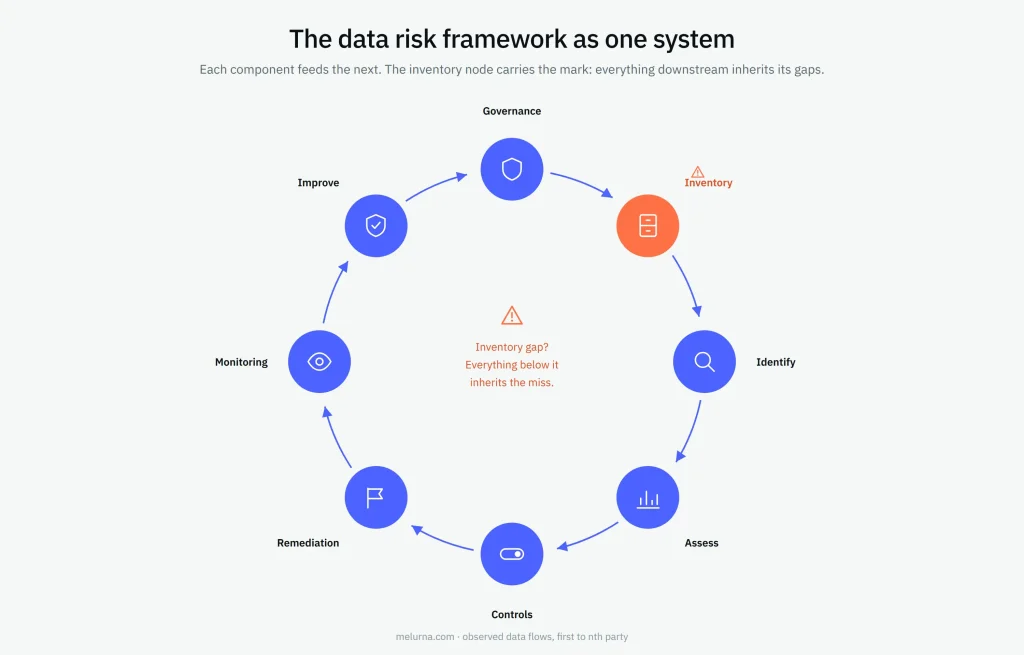
Pay special attention to the inventory. Assessment, controls, and monitoring all depend on what is listed there. If the inventory is incomplete, every following step will be wrong, even if well documented.
Which standard should anchor your data risk management framework?
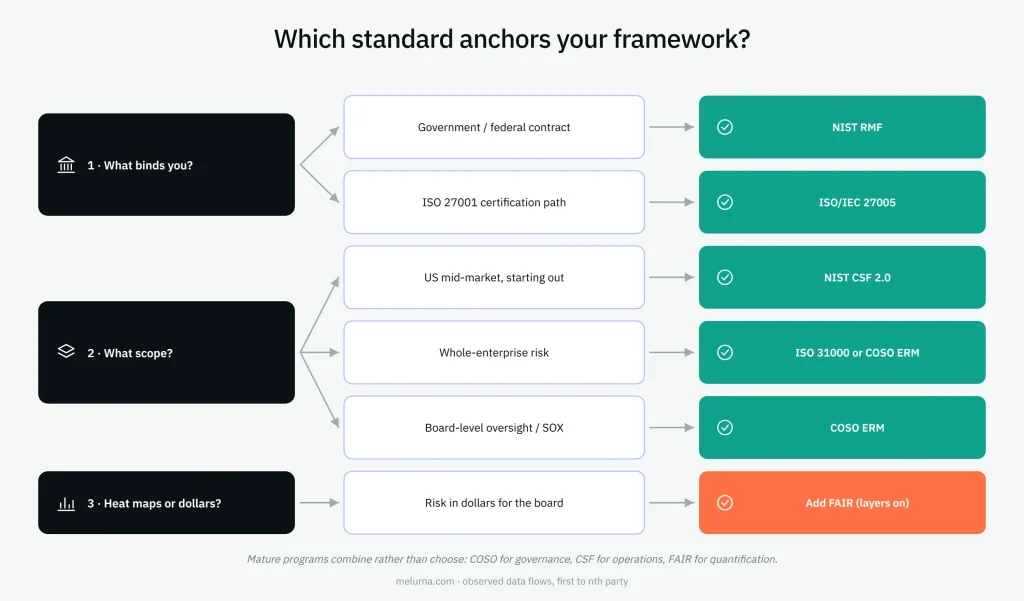
Each standard addresses different needs, so the real question is not which is best, but which fits the question you are trying to answer:
| Standard | What it is | Shape | Best fit |
| NIST CSF 2.0 | Six-function outcome taxonomy: Govern, Identify, Protect, Detect, Respond, Recover | Qualitative, non-prescriptive, sector-neutral | Mid-market starting point; US regulatory alignment |
| NIST RMF (SP 800-37) | Seven-step life cycle: Prepare, Categorize, Select, Implement, Assess, Authorize, Monitor | Prescriptive, control-based | Federal systems, government contractors, regulated industries |
| ISO 31000:2018 | Principles, framework, and process for risk management generally | Guidelines, not certifiable | The enterprise umbrella above everything else |
| ISO/IEC 27005:2022 | Risk-management guidance tailored to information security, supporting ISO 27001 | Structured process, not itself certifiable | Organizations pursuing or holding ISO 27001 certification |
| FAIR (Open FAIR) | The Open Group’s standard quantitative model: risk expressed in financial terms | Quantitative, a complement rather than a substitute | Boards and budgets: when you need dollars, not heat maps |
| COSO ERM | Enterprise risk governance frame, “Integrating with Strategy and Performance” (2017) | Governance-first | Board-level oversight, SOX-adjacent environments |
Three decision gates get you to an answer:
- What binds you? Federal contractor work points to RMF. An ISO 27001 certification path points to ISO 27005. SOX-heavy governance points to COSO.
- What scope? Data- and security-specific work: CSF or 27005. Whole-enterprise risk: ISO 31000 or COSO.
- Qualitative or quantitative? If leadership wants loss exposure in currency, add FAIR, which layers onto others rather than replacing them.
Mature risk management programs combine rather than choose. COSO covers the governance frame, CSF the operational structure, FAIR the board’s question of what a risk costs. (NIST SP 800-39 sits a tier above RMF: “an integrated, organization-wide program for managing information security risk,” enterprise-level guidance deliberately complementary to ERM.)
How does the framework map to the data lifecycle?
Data risk is not evenly distributed. It concentrates at transitions when data moves between stages, systems, or organizations. Walking the lifecycle is how you find where data protection controls belong:
| Stage | Characteristic risk | Control class |
| Creation / collection | Over-collection, unclassified data entering the system | Classify at creation, collect with purpose |
| Storage | Misconfiguration, unencrypted stores, shadow copies | Encryption, access control, approved locations |
| Use | Excessive access, untracked processing | Least privilege, logging, purpose binding |
| Sharing | Unvetted recipients, insecure channels, scope creep | Third-party agreements, secure transfer, tracking |
| Archival | Forgotten data outliving its purpose | Retention schedule enforcement |
| Destruction | Data “deleted” on schedule but not in fact | Verifiable, documented destruction |
The data retention policy guide details floors, ceilings, legal holds, and the schedule itself. When a control fails anyway, the privacy incident outlines what counts as a reportable incident. The stages where data moves, sharing above all, are where frameworks lose track of it.
How do you build a data risk management framework, step by step?
Sequence beats comprehensiveness. Ownership comes before inventory because an inventory nobody owns is stale by next quarter:
1. Sponsor and scope
Name the executive sponsor and the framework’s owner. Decide what data and which business units and business processes are in scope for cycle one.
Output: charter.
2. Gap analysis
Compare current practice against your anchor standard and the regulatory requirements that bind you.
Output: gap register.
3. Build the data inventory and classify
Catalog data assets and flows, then label sensitive data by classification level. Include every place sensitive data lives or moves, including the website, which is where this step usually fails.
Output: the inventory.
4. Run the data risk assessment
Identify potential threats per asset, score likelihood and impact, and prioritize. The data risk assessment method is in depth in the data privacy risk guide.
Output: ranked risk list.
5. Select controls and treatments
Risk mitigation, risk transfer, risk avoidance, or risk acceptance (the four risk treatments), decided per risk, in writing.
Output: treatment plan.
6. Stand up the register and cadence
Risks, owners, scores, and review dates live in one place: the risk register (fields, scoring mechanics, failure patterns).
Output: the living register.
Download the template | Sample Sheet
7. Set up continuous monitoring and review
Risk indicators run continuously, and the assessment re-runs annually and on material change.
Output: review calendar and dashboard.
What does a data risk management framework look like in practice?
A composite example, clearly a composite, assembled from the patterns above.
Meridian is a 300-person subscription retailer. The GC sponsors. Ownership of the framework sits with the head of IT ops. Scope is customer data and the e-commerce stack. A gap analysis against NIST CSF finds policy documents but no inventory and no testing. The inventory team catalogs the production database, the CRM, the analytics warehouse, cloud storage, and the email platform. Classification runs four levels: public, internal, confidential, restricted.
Then someone asks about the website.
The website was never in the inventory because it “doesn’t store anything.” Nobody had looked. A review of what the browser actually sends finds the account-login page loading a dozen third-party scripts, two receiving page URLs carrying email addresses from a “prefill” feature, plus a tag manager marketing edits without review. Meridian’s risk assessment scored “unauthorized disclosure of customer data” as low-likelihood (based on server controls) while the browser disclosed identifiers to third parties on every authenticated pageview.
The build proceeds honestly. Website flows join the inventory as first-class assets, the risk list gains browser-layer items, tag governance and field-level rules become controls, and the register records owners and review dates. Recurring observation of what the site sends becomes the monitoring feed. The framework didn’t change shape. It changed coverage.
Who owns the framework, and what does the board need to see?
A framework without named ownership degrades into documentation. The role set that works at mid-market scale is:
| Role | Accountable for |
| Executive sponsor | Resources, risk appetite, board interface |
| Framework owner (GRC lead / DPO / CISO delegate) | The method, the cadence, the register’s integrity |
| Data owners | Risk decisions for their domain’s data |
| Data stewards | Day-to-day classification and quality |
| Control owners vs. reviewers | Separation between running a control and checking it |
The people who operate the systems own the risk. Risk and compliance own the framework. Audit, internal or external, assures both. Where headcount is thin, one person can wear two hats, but never the control-owner and reviewer hats on the same control.
The board and senior management need orientation: current top exposures, trend since last quarter, anything past its threshold, and what you need from them. GLBA’s Safeguards Rule writes exactly this into law for its sector (the qualified individual reports in writing to the board at least annually), and it is a sensible cadence everywhere else.
How do you measure whether the framework is working?
Separate the two questions dashboards love to merge:
| KPI: program metrics | KRI: exposure metrics | |
| Measures | How well the program runs | How much risk you currently carry |
| Direction | Lagging | Leading |
| Examples | Assessment-cycle time, % findings closed on time, training completion | Unclassified data stores found, overdue high-risk remediations, new third-party recipients detected |
| Reviewed | Monthly / quarterly | Continuously; threshold breaches escalate |
Two rules keep metrics honest. First, a small core set: ten to fifteen well-defined indicators beat forty that nobody reads. Second, every metric needs a threshold and a named action. A number that worsens with no attached decision is decoration, not monitoring.
Tooling categories that support this layer: data discovery, data loss prevention, access governance, monitoring tools. Categories, not vendors: the framework dictates the tooling, never the reverse.
Where do data risk frameworks fail?
These programs fail in five predictable ways, each with a mechanism and an early warning:
- Documentation-exercise programs. Assessments get produced, and decisions don’t change. Early warning: last year’s risk register and this year’s are the same document with a new date.
- Siloed ownership, incompatible scales. Security and compliance score on different definitions of “high.” Early warning: two departments argue about a rating instead of a fix.
- Point-in-time treated as continuous. An annual assessment answering a question that changes weekly. Early warning: a new SaaS tool or tag went live without touching the register.
- Aging inventory. The discovery scan ran once, at implementation. Early warning: the inventory’s “last updated” column is the go-live date.
- Questionnaire theater. Vendor risk assessed by what vendors say about themselves. Early warning: every vendor scores “acceptable” every year.
Every one of these is a stated-versus-observed failure: the program says one thing, reality does another. Which brings us to the gap the standards can’t close for you.
What data risks does your framework’s inventory never see?
Server-side data is structurally blind to the layer where your website hands sensitive data to third parties directly from the visitor’s browser: tags, pixels, SDKs, chat widgets, session-replay scripts, consent-dependent flows, and the fourth parties your approved vendors load behind themselves. Each of those flows is a data exposure no server log records.
In one classic measurement study, viewing a local ad on the Home Depot site sent the visitor’s first name and email address to 13 companies; a mistyped Wall Street Journal password page sent the user’s email to seven (IEEE S&P).
And regulators have started naming the layer directly:
- PCI DSS 4.0 requires merchants to inventory, authorize, and integrity-check the scripts running on payment pages, and to run change-and-tamper detection on them (Requirements 6.4.3 and 11.6.1): the browser layer, written into a standard.
- HHS’s proposed HIPAA Security Rule update (December 2024, still proposed as of this writing) would require a technology asset inventory and a network map showing how ePHI moves, refreshed at least every 12 months.
- The litigation record supplies the consequences: the Advocate Aurora Health pixel settlement (E.D. Wis., 2:22-cv-1253) exists because patient-visit data flowed to Meta and Google through tracking pixels, a flow the framework’s inventory never listed.
Our data leakage guide covers the mechanics of data leakage (what triggers it, what it carries, and who receives it), and the web tracking guide explains how to observe it.
At the framework level, the point is simpler. If the inventory misses the browser, the assessment under-scores third-party and compliance risk, controls aim at the wrong layer, and monitoring watches the wrong wire. Every component inherits the gap.
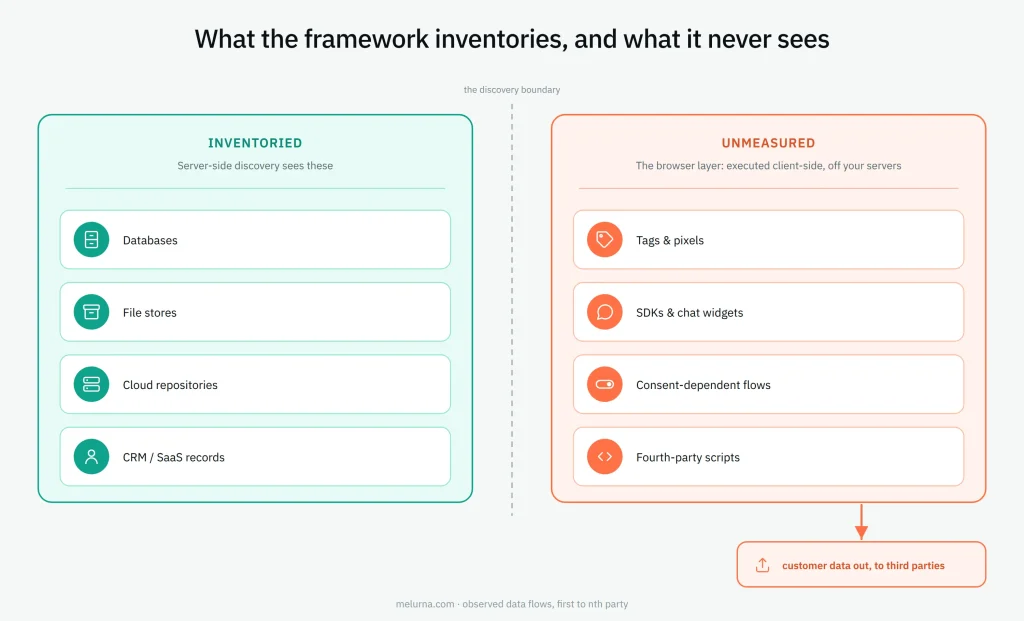
Closing the gap means observing what the site sends, not attesting what it should send. That is the layer MELURNA monitors: sensitive-data journeys across websites, apps, and customer journeys, hidden recipient chains beyond the first vendor hop, and stated-versus-observed gaps between what policies say and what browsers do.
How do you verify the framework’s controls actually work?
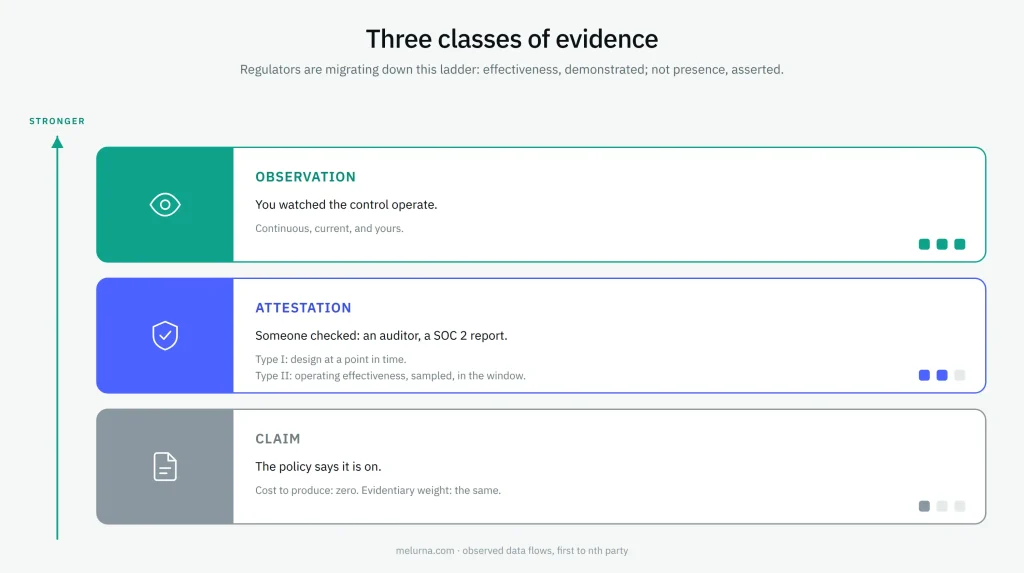
Evidence comes in three classes, and they are not interchangeable:
- Claims. The policy says encryption is on. The vendor questionnaire says access is reviewed. Cost to produce: zero. Evidentiary weight: the same.
- Attestation. Someone checked: an auditor, a certification, a SOC 2 report. Stronger, but note what even the strong version is: a Type I report evaluates control design at a point in time. A Type II covers operating effectiveness over a period, on a sample, inside the audit window. Attestation is somebody else’s observation, bounded in scope and time.
- Observation. You watched the control operate: the access review happened, the encryption is on the wire, the website’s scripts send what the policy says they send. Continuous, current, and yours.
Regulators are migrating down this ladder. GDPR Article 32(1)(d) requires “a process for regularly testing, assessing and evaluating the effectiveness” of security measures. GLBA’s Safeguards Rule requires regular testing or monitoring of key controls, with continuous monitoring as the stated alternative to periodic penetration tests. The direction of travel is demonstrated effectiveness, not asserted presence.
Sort your framework’s controls into the observable and the attestation-bound. Server-side controls often have logs that verify them. The website layer is observable too if you monitor it from outside the page rather than trusting the tag manager’s config screen. This kind of observation covers the client side. Server-to-server flows that never touch a browser sit outside what anyone can observe from the page, and a credible program says so.
What’s next
- Run the assessment: How to assess data privacy risk?
- Stand up the register: What is a risk register?
- See what your website actually sends: reserve a review slot
FAQs
What are the components of a risk management framework?
Governance and ownership, inventory and classification, risk identification, assessment, controls and treatment, issue management, monitoring and reporting, continuous improvement. The components section above gives each one a “done” test.
What are the seven steps of the NIST Risk Management Framework?
Prepare, Categorize, Select, Implement, Assess, Authorize, Monitor, per NIST SP 800-37. Prepare was added in Revision 2, which is why older material lists six.
What are examples of risk management frameworks?
NIST CSF 2.0, NIST RMF, ISO 31000, ISO/IEC 27005, FAIR, and COSO ERM, compared with a chooser in the standards section above.
What are some examples of data management risks?
External attack, insider threats, third-party exposure, operational loss or corruption, and compliance violations; the common-risks section gives the mechanism behind each.
How do you create a risk management framework?
Sponsor and scope first, then gap analysis, inventory, assessment, controls, register, monitoring. The build section names the artifact each step produces.
What is the purpose of NIST SP 800-39?
It guides “an integrated, organization-wide program for managing information security risk,” the enterprise tier above the RMF’s system-level process, written to complement a broader ERM program (NIST SP 800-39).
DISCLAIMER: This guide is for general informational purposes only and does not constitute legal advice. While we strive for accuracy, we make no warranties about the completeness or reliability of this information, and are not liable for any errors, omissions, or actions taken based on its contents. Consult a licensed attorney for guidance specific to your business.