
The CCPA does not require a cookie banner. No provision of the statute or the California Privacy Protection Agency’s regulations mandates one. The regulations go further: under 11 CCR §7026(a)(4), a cookie banner alone is not an acceptable method for submitting opt-out requests. California is an opt-out regime, and what the law requires is a set of named mechanisms: a notice at collection, a “Do Not Sell or Share My Personal Information” link, and honoring the Global Privacy Control signal.
Healthline had everything in place: a consent banner, a Do Not Sell or Share webform, and support for Global Privacy Control. But even when users rejected cookies, about 118 third-party advertising cookies still loaded on the site. In July 2025, the California Attorney General announced a $1.55 million settlement. What users saw on the banner did not match what was actually happening behind the scenes.
Key takeaways
- The CCPA does not require a cookie banner, and a banner alone is not even an acceptable opt-out submission method (11 CCR §7026(a)(4)). The law names mechanisms instead.
- The five duties: notice at collection, the Do Not Sell or Share link, the Limit-Use link where sensitive data triggers it, GPC honoring, and submission mechanics that make opt-outs real.
- Sale-and-sharing opt-in consent has exactly four doors: minors, the 12-month re-ask, sensitive PI beyond permitted purposes, and financial incentives. A fifth consent duty, §7002(e), covers purposes that fail necessity and proportionality.
- A deployed banner is regulated by §7004: symmetry in choice, no dark patterns, and closing the banner is not consent, an example the 2026 package wrote expressly into §7004(a)(3)(D).
- Since January 1, 2026, businesses must visibly confirm a processed opt-out signal (“Opt-Out Request Honored”), the may-to-must flip in §7025(c)(6).
- The enforcement record, as of October 2026, punishes five failure patterns at adjusted penalties of $2,663 and $7,988 per violation, with no cure period since 2023. Most had a banner or consent tool in place.
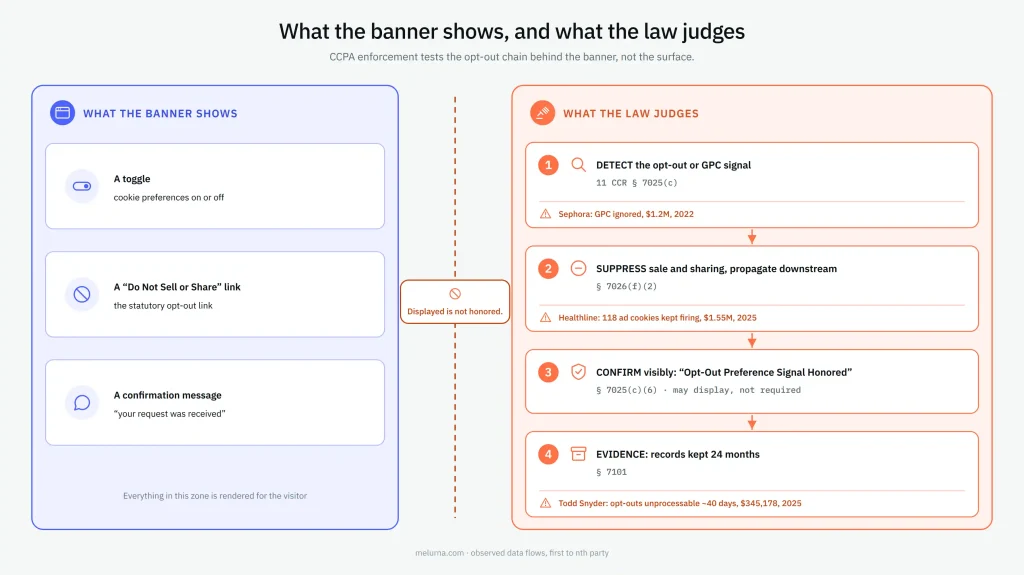
- Displayed is not honored: working means the full detect, suppress, confirm, evidence chain, and only observed behavior proves it.
This article is for DPOs, privacy counsel, and web operations teams. It explains CCPA cookie banner requirements and the difference between what your cookie banner shows and what the law considers true compliance.
Does the CCPA require a cookie banner?
No, and the law does not accept one as a substitute for compliance either. Nothing in the California Consumer Privacy Act (CCPA, Cal. Civ. Code §1798.135) or the CPPA’s regulations (11 CCR §§7000 et seq., current text effective January 1, 2026) obliges a website to display a cookie banner.
California runs on opt-out, not opt-in: most tracking may run by default, provided the consumer’s right to stop the sale and sharing of their personal information actually works. What the statute names is machinery. The regulations close the loop from the other side: under 11 CCR §7026(a)(4),
“A notification or tool regarding cookies, such as a cookie banner or cookie controls, is not by itself an acceptable method for submitting requests to opt-out of sale/sharing.”
A cookie banner by itself does not meet the opt-out requirements, and it is not enough for full compliance.
| The assumed requirement | What the law actually names |
| “Show a cookie banner before any tracking starts” | Nothing. No provision mandates a banner. The default is opt-out, not opt-in |
| “Get consent before cookies fire” | Opt-in consent in four named situations only: minors, the 12-month re-ask, sensitive data beyond permitted purposes, financial incentives (detailed below) |
| “An accept/reject popup as the compliance answer” | Mechanisms: notice at collection (Cal. Civ. Code §1798.100(b)), opt-out links (§1798.135), Global Privacy Control honoring (11 CCR §7025) |
| “The banner is the opt-out channel” | A banner alone is not an acceptable submission method (11 CCR §7026(a)(4)) |
| “California’s Cookie Act” | No standalone cookie statute exists. The rules above come from the CCPA and its regulations |
The confusion has an origin: banners are a GDPR-shaped habit, imported from EU practice where prior consent is the default.
If your site also serves EU visitors, the consent defaults invert. One adjacency to keep separate: banners also feature in wiretap-style litigation under the California Invasion of Privacy Act. Effective January 1, 2027, SB 690 narrowed that theory for website operators.
Does the CCPA apply to your website?
It applies if your business passes a three-part gate and meets any one of three thresholds, and where the business is located is irrelevant:
- The business is for-profit
- Does business in California
- Determines the purposes and means of processing consumers’ personal information (Cal. Civ. Code §1798.140(d)).
It is the consumer’s location that matters, not where the business is based. So, if a company outside California collects California residents’ personal information and meets the requirements, it must follow the CCPA.
| Threshold test (any one suffices) | Current figure | Common misreading |
| Annual gross revenue | Above $26,625,000, effective January 1, 2025 | “$25 million,” the pre-adjustment figure still repeated across most of the ranking explainers |
| Volume of personal information | Buys, sells, or shares the personal information of 100,000 or more consumers or households | “100,000 website visits,” an overread. The California Privacy Rights Act (CPRA) narrowed this prong by deleting “devices” and casual “receives for commercial purposes” language |
| Revenue share | 50% or more of annual revenue from selling or sharing consumers’ personal information | Counting only “sales.” Sharing for cross-context behavioral advertising counts too |
That revenue figure is inflation-adjusted. The CPPA announced the current amount on December 17, 2024 (CPI adjustment announcement, with the adjusted schedule on its CPI adjustment page). All figures here date to October 2026. The next reset lands January 1, 2027, and adjustments recur in odd-numbered Januaries (§1798.199.95(d)).
More details in: What is the CCPA? | CCPA compliance guide
If not a cookie banner, what does the CCPA actually require?
The CCPA requires businesses to meet five main duties, each linked to a specific law. None of these duties is simply a banner. A banner can help with some of them, but the legal obligations belong to the business, not just the tool.
| Duty | Provision | Operational demand |
| 1. Notice at collection | §1798.100(b), 11 CCR §7012 | Disclose what is collected, why, whether it is sold or shared, and how long it is kept, at or before collection |
| 2. “Do Not Sell or Share My Personal Information” link | §1798.135(a)(1), 11 CCR §7013 | A clear and conspicuous link on the homepage and pages that collect personal information |
| 3. “Limit the Use of My Sensitive Personal Information” link, or the combined “Your Privacy Choices” alternative | §1798.135(a)(2)–(3), 11 CCR §§7014, 7015 | Required only when sensitive personal information is used beyond permitted purposes |
| 4. Honor opt-out preference signals (Global Privacy Control) | 11 CCR §7025 | Process the browser or device signal as a valid opt-out request, and display confirmation |
| 5. Submission mechanics that make opt-outs real | 11 CCR §7026 | Two or more methods for submitting opt-outs (a banner alone does not count, §7026(a)(4)). No account creation or unnecessary verification. Comply within 15 business days, not the 45 days allowed for requests to know, delete, or correct (§1798.130(a)(2)), and notify downstream third parties (§7026(f)). Provide confirmation (§7026(g)). No re-asking for 12 months (§7026(k)). 24-month records (§7101) |
Duty 2 carries a genuine either/or. A business that processes opt-out preference signals frictionlessly (no fee, no verification, no pop-up in response) may drop the “Do Not Sell or Share” link (§7013(d), §7025(f)–(g)), though the Notice of Right to Opt-out of Sale/Sharing must still be posted. The reverse is never true. Posting the links never excuses ignoring the signal.
Duty 5 is where banners are most important. It involves a four-step process that must be followed.
- Detect the choice wherever it arrives: banner toggle, link click, or the GPC signal, which covers the browser or device and the known consumer (§7025(c)(1)).
- Suppress the sale and sharing it covers, actually stopping the flows and propagating the choice downstream to third parties (§7026(f)).
- Confirm the processed opt-out visibly, mandatory since January 1, 2026 (§7025(c)(6)).
- Evidence the handling with records of consumer requests and responses kept for 24 months (§7101).
What must the notice at collection say about cookies?
Six elements, by category rather than by cookie (§7012(e)).
- The categories of personal information collected, including sensitive categories, in plain wording
- The purposes for each category
- Whether each category is sold or shared
- The retention period or the criteria used to set it
- A link to the opt-out notice if the business sells or shares
- A link to the privacy policy
Cookies map onto the “identifiers” (such as cookie IDs and IP addresses) and “internet or other electronic network activity” categories of §1798.140(v), so the notice describes what trackers collect by category, not a cookie-by-cookie inventory.
Online, the notice link must go directly to the specific privacy-policy section containing those six elements. A link to the top of the policy fails (§7012(f)). And if a third party, such as an ad network, controls collection on your site, that third party owes its own notice, though a combined notice is allowed (§7012(g)).
What does the “Do Not Sell or Share” link have to do?
The link must appear, clear and conspicuous, on the homepage and on any page where personal information is collected (§1798.135(a)(1)). Titled “Do Not Sell or Share My Personal Information,” it leads to a page where the consumer can actually opt out. Businesses that also owe the Limit-Use link may combine both into a single “Your Privacy Choices” link, displayed with the regulation’s opt-out icon (§7015). A banner can carry the link. It cannot be the whole mechanism.
When is the “Limit the Use” link required?
Using or disclosing sensitive personal information beyond the permitted purposes in 11 CCR §7027, things like precise geolocation, account credentials, or government identifiers such as a driver’s license number used for advertising. Below that line, the third link is optional. Above it, the consumer must be able to limit the use (§1798.121, §7014).
Do you have to honor Global Privacy Control (GPC)?
Yes. California treats an opt-out preference signal such as Global Privacy Control (sent as the Sec-GPC header, or exposed to scripts as navigator.globalPrivacyControl) as a valid opt-out request that the business must process (§7025(c)).
Honoring means treating it as a Do Not Sell or Share instruction for that browser, device, and, where known, that consumer, without adding friction in response.
→ Read Global Privacy Control signal mechanics
Which cookies count as selling or sharing?
The contract decides, not whether a tracker sets first-party or third-party cookies. “Sale” is disclosure for monetary or other valuable consideration (§1798.140(ad)). “Sharing” is disclosure for cross-context behavioral advertising, with or without consideration (§1798.140(ah), (k)), the CPRA addition that captures most adtech. Run each tracker through the decision table:
| Tracker type | Classification | Verdict | What flips it |
| First-party analytics under a genuine service-provider contract | Neither sale nor sharing | Runs by default under opt-out rules | The vendor reusing the data for its own purposes fails the service-provider test regardless of the paper label |
| Ad pixels, retargeting tags, programmatic partners | Sharing (often sale too) | Opt-out machinery must cover them | A consumer direction to disclose (§1798.140(ad)(2)(A)) removes the disclosure from “sale,” the theory behind opt-in banners as risk mitigation |
| General analytics with advertising features enabled | Configuration-dependent | Audit the setup | Enabling advertising features or signals sharing moves it into “sharing” |
When does the CCPA require opt-in consent?
Four situations, and only four, flip the sale-and-sharing default from opt-out to opt-in. Everything else runs on the machinery above.
| Situation | Whose consent | Provision |
| Selling or sharing the personal information of a consumer under 16, with actual knowledge (willful disregard counts) | The minor, if aged 13 to 16. A parent or guardian, if under 13 | §1798.120(c), 11 CCR §§7070–7072 |
| Asking a consumer to opt back in within 12 months of their opt-out | The consumer | 11 CCR §7026(k), §7027(l) |
| Using or disclosing sensitive personal information beyond permitted purposes after the consumer has limited it, or where no Limit notice was posted | The consumer | §1798.121(b), 11 CCR §7014(h) |
| Enrolling a consumer in a financial incentive program | The consumer | §1798.125(b), 11 CCR §7016 |
The minors door is now enforced: the Jam City settlement in the enforcement record below is a minors-consent action.
One adjacent duty sits outside the sale-and-sharing frame: 11 CCR §7002(e) requires §7004-compliant consent before collecting or processing personal information for any purpose that fails the necessity-and-proportionality test in §7002(a).
No matter the situation, consent must meet the legal standard: it must be freely given, specific, informed, and clear (§1798.140(h)). Silence or doing nothing does not count as consent. Consent obtained through a dark pattern does not count at all.
If you use a cookie banner, what rules does the CCPA impose?
California does not require a cookie consent banner, but if you use one to offer privacy choices, 11 CCR §7004 sets the rules for how it must work. A banner that lets users make choices is regulated, not just for show.
Section 7004(a) names five principles for any method of submitting requests or obtaining consent.
- Easy-to-understand language
- Symmetry in choice
- No confusing language or interactive elements
- No choice architecture that impairs or interferes with the consumer’s ability to choose
- Easy execution without unnecessary burden or friction
The regulation is example-driven, naming the losing designs outright. A cookie banner trips these:
| Fails §7004 | Passes |
| “Accept All” beside only “More Information” or “Preferences” (§7004(a)(2)(C)) | “Accept All” beside “Decline All” |
| “Yes” paired with “Ask me later” (§7004(a)(2)(B)) | “Yes” beside “No” |
| A “yes” button larger or in a more eye-catching color than “no” (§7004(a)(2)(D)) | Equal size and prominence |
| Treating a consumer who closes or navigates away from the pop-up as consenting (§7004(a)(3)(D)) | Affirmative selection only |
| Opting out of sale/sharing takes more steps than opting back in, measured from the “Do Not Sell or Share” link click to completion (§7004(a)(2)(A)) | Same or fewer steps each way |
| Double negatives, misleading omissions, unlabeled toggles (§7004(a)(3)) | Plain, labeled controls |
| Countdown-clock false urgency, disruptive interstitials, bundled consents (§7004(a)(3)–(4)) | One choice, plainly stated, no pressure mechanics |
Consent obtained through a dark pattern “shall not constitute consumer consent” (§7004(b)). A vendor or consent management platform (CMP) template is no excuse.
The CPPA’s Enforcement Advisory 2024-02 (September 4, 2024) wraps user interfaces deployed through service providers, CMPs included. Its doctrine, in one line: “Dark patterns are about effect, not intent.” Section 7004(c) writes the same rule into the regulation: an interface the business knows of and does not remedy is a dark pattern, whatever the intent.
Your banner is just one part of a larger system of consent states, such as accept, reject, no action, and GPC signals. Our web-tracking guide explains what each state should trigger behind the scenes.
What must a compliant CCPA cookie banner contain?
| Element | Layer | Rule | Provision |
| Symmetrical accept/reject pair | Layer 1 (the banner face) | Equal steps and equal prominence | §7004(a)(2) |
| Notice at collection link | Layer 1 | At or before collection. Deep link to the specific policy section | §1798.100(b), §7012(e)–(f) |
| “Do Not Sell or Share My Personal Information” or combined “Your Privacy Choices” link with icon | Layer 1 or persistent footer | Exact statutory wording | §1798.135(a), §7015 |
| “Limit the Use of My Sensitive Personal Information” link | Layer 1 or footer | Only when sensitive-PI use triggers it | §1798.135(a)(2), §7014 |
| Granular preference center | Layer 2 (behind a “Preferences” path) | Labeled toggles, no double negatives | §7004(a)(3) |
| Visible opt-out-signal confirmation | Layer 1 | “Opt-Out Request Honored”-style display | §7025(c)(6) |
Does closing the banner count as consent?
No. Section 7004(a)(3)(D), added by the package effective January 1, 2026, makes it clear: closing or leaving a consent pop-up without clicking “I accept” does not count as consent. This rule builds on an older principle. Since January 1, 2023, consent gained through dark patterns has not been valid (§1798.140(h)). The 2026 update specifically says that closing a banner cannot be treated as acceptance.
What is “symmetry in choice”?
Symmetry in choice means the path to the more privacy-protective option cannot be longer, more difficult, or more time-consuming than the path to the less protective one (§7004(a)(2)).
What changed about CCPA cookie rules in 2026?
The headline change took effect January 1, 2026: businesses must now display whether they have processed a consumer’s opt-out preference signal, where the old text said they may. Section 7025(c)(6) carries the one-word flip. It sits in the CPPA rulemaking package the Board adopted on July 24, 2025.
The Office of Administrative Law approved it in September 2025. Its example display: “Opt-Out Request Honored”. A confirmation the user never sees does not satisfy the rule. From the same package: new dark-pattern worked examples in §7004, and the personal information of consumers under 16 joins the sensitive-PI categories (§7001(bbb)(4)).
| Date | Requirement | Provision | What your banner/opt-out must do |
| January 1, 2026 | Visible confirmation of processed opt-out signals (may became must) | §7025(c)(6) | Display honored status, for example “Opt-Out Request Honored” or a toggle state |
| January 1, 2026 | Expanded dark-pattern worked examples | §7004 | Audit banner copy, layout, and flow against the named failing designs |
| January 1, 2026 | Under-16 personal information joins sensitive-PI categories | §7001(bbb)(4) | Limit-use duties now reach known teen data |
| January 1, 2027 | Opt Me Out Act (AB 566) operative | Civ. Code §1798.136 | Nothing new directly. Expect sharply higher GPC volume to honor |
| January 1, 2027 | ADMT (automated decision-making) rules begin | 11 CCR art. 11 | Advertising is expressly out of scope, so no banner impact |
| April 1, 2028 | First risk-assessment attestation due | 11 CCR art. 10 | Selling or sharing personal information is a trigger activity, so document adtech flows |
| 2028–2030 | Cybersecurity audits phase in by revenue tier | 11 CCR art. 9 | Banner-adjacent only, a program-level duty |
This package phases in through 2030, so re-check the CPPA’s rulemaking calendar before relying on any single date.
What arrives in 2027?
AB 566, the Opt Me Out Act, adds Civil Code §1798.136. It becomes operative January 1, 2027. It binds browser makers, not websites. Browsers must ship consumer-configurable opt-out-signal functionality.
For a site operator, the direct duties are unchanged. What changes is the volume: more of your traffic will arrive carrying a binding opt-out signal.
What has CCPA enforcement punished at the cookie-banner layer?
The banner- and opt-out-layer enforcement record, as of October 2026, spans eleven actions, two enforcers, and one recurring theme. A banner or consent tool was in place in most of them. What failed was the behavior behind it.
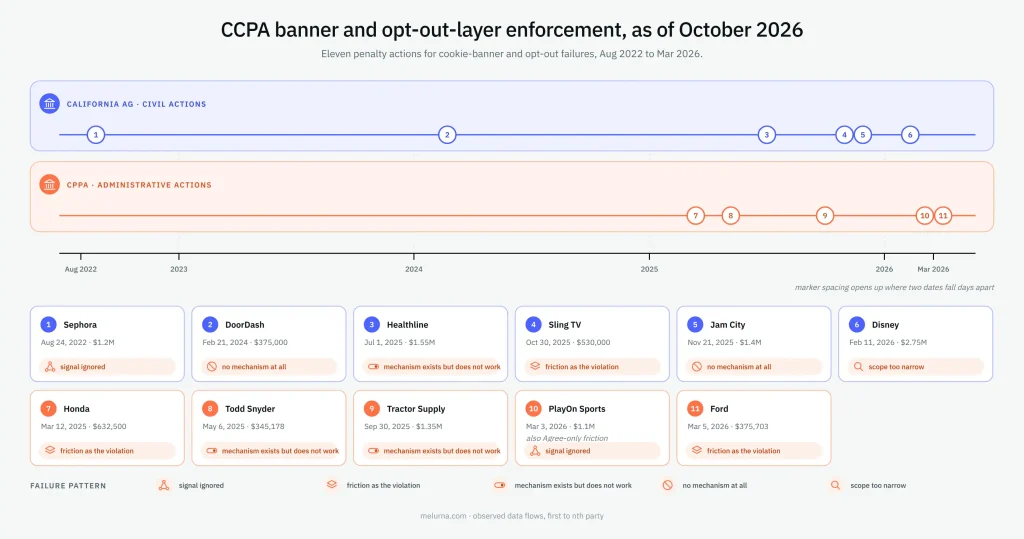
| Case | Date | Amount | Enforcer | Banner-layer failure | Injunctive term |
| Sephora | Aug 24, 2022 | $1.2M | CA AG | GPC signals ignored. No working Do-Not-Sell. Sale undisclosed. 30-day cure missed | GPC-honoring mechanisms. Reporting to the AG |
| DoorDash | Feb 21, 2024 | $375,000 | CA AG | No mechanism at all: invisible sale to marketing co-ops, no notice, no opt-out | Vendor-contract review. Annual reports on sale/sharing |
| Honda | Mar 12, 2025 | $632,500 | CPPA | Asymmetric choice: one click to allow, two steps to reject. Verification friction on opt-outs | “Reject All” parity. UX designer review of request flows |
| Todd Snyder | May 6, 2025 | $345,178 | CPPA | Misconfigured CMP banner flashed and vanished. Opt-outs unprocessable for about 40 days. Photo ID demanded | Monitoring procedures for opt-out mechanisms. Staff training |
| Healthline | Jul 1, 2025 (judgment Jul 28) | $1.55M | CA AG | Banner, webform, and GPC handling all logged choices while roughly 118 third-party ad cookies kept firing. About 65,000 Californians’ opt-outs ineffective | Working opt-outs verified. Article-title transmissions banned. Contract audits |
| Tractor Supply | Sep 30, 2025 | $1,350,000 | CPPA | Do-Not-Sell webform did not stop tracker-based sale/sharing. GPC unprocessed until about July 2024 | Five years of public metrics reporting. Quarterly tracker scans |
| Sling TV | Oct 30, 2025 | $530,000 | CA AG | Cookie preferences presented as the CCPA opt-out. Multi-step webform even for logged-in users. No opt-out inside the apps | Minimal-step opt-out without re-collecting known data. In-app opt-out. Kids’ profiles |
| Jam City | Nov 21, 2025 | $1.4M | CA AG | No compliant opt-out in any of 21 mobile apps. Data of 13-to-16-year-olds sold or shared without opt-in consent | In-app opt-out methods. Affirmative consent for minors |
| Disney | Feb 11, 2026 | $2.75M | CA AG | Opt-out scoped per device and per service, even for logged-in users. Webform never reached in-app adtech | Opt-out methods that fully stop sale/sharing across devices and services |
| PlayOn Sports | Mar 3, 2026 (order Feb 27) | $1.1M | CPPA | “Agree”-only banner with no way to close it without agreeing. Opt-out preference signals unrecognized | Quarterly tracker scans. Risk assessments. Signal processing per §7025 |
| Ford | Mar 5, 2026 | $375,703 | CPPA | Email verification demanded before opt-out. Unverified requests silently dropped | Audit of all trackers for §7025 signal handling |
The failures sort into five patterns:
- Signal ignored (Sephora, PlayOn Sports)
- A mechanism that exists but does not work (Todd Snyder, Tractor Supply, Healthline)
- Scope too narrow (Disney)
- Friction as the violation (Honda, Ford, Sling TV, and PlayOn’s Agree-only design)
- No mechanism at all (DoorDash, Jam City)
Regulators also coordinate and test empirically. On September 9, 2025, the California AG, the CPPA, and the Colorado and Connecticut AGs announced a joint investigative sweep. The target was businesses that did not appear to be processing GPC opt-outs. Investigators screened behavior, not displays: whether a site appeared to process the signal at all.
What are the fines per violation?
| Provision | Classic figure | Current figure | Notes |
| Administrative fines (§1798.199.90) and civil penalties (§1798.155), per violation | $2,500 | $2,663 | Adjusted January 1, 2025 |
| Same, intentional violations or known under-16 consumers | $7,500 | $7,988 | Adjusted January 1, 2025 |
| Private action, per consumer per incident (§1798.150) | 100–750 | 107–799 | Data breach claims only. Banner and opt-out violations are not privately actionable |
The next reset lands January 1, 2027. Exposure multiplies because penalties stack per violation, and the Honda order spelled out consumer counts to make the point. There has been no cure period since January 1, 2023, so the old “30 days to fix it” buffer, part of the CCPA since it took effect on January 1, 2020, is gone.
Can one cookie banner cover both CCPA and GDPR?
A single cookie banner can only cover both CCPA and GDPR if it changes its behavior depending on the law. The rules are opposite: GDPR blocks non-essential cookies until users opt in, while CCPA allows trackers by default but requires a way to stop them. One setup cannot meet both requirements at once.
Two deployment patterns are lawful.
- Geo-targeted: EU visitors get the blocking opt-in template. California visitors get notice plus the opt-out links and GPC honoring.
- GDPR-style globally: prior opt-in cookie consent for everyone, lawful under the CCPA at the cost of US conversion.
One pattern fails both: the GDPR-style banner with no “Do Not Sell or Share” link and no GPC handling. At the edges, the clean contrast breaks. California’s minors opt-in and sensitive-PI limits have no GDPR mirror and need their own separate handling.
For the dimension-by-dimension comparison, see our GDPR explainer.
Does your cookie banner actually do what it claims?
The enforcement record above catalogs banners whose behavior differed from their display. Displayed is not honored. Every opt-out on your site either completes the four-stage chain from the requirements section or it does not. For example, Healthline broke at suppress, Todd Snyder at evidence, and Ford engineered friction into the mechanism before the chain even started.
A CMP dashboard sits at stage one of that chain.
- It proves a choice was recorded: the toggle state, the timestamp, the banner version shown.
- It cannot prove the stages the law punishes: whether downstream tags actually stopped, whether third-party recipients changed behavior, whether the GPC signal reached anything beyond the consent layer.
Healthline had a CMP, and the advertising cookies kept firing anyway. A peer-reviewed USENIX Security 2025 study crawled 11,708 US sites between December 2023 and April 2024. Among sites with evidence of selling or sharing that implemented a privacy-compliance string, only 45% fully honored the GPC signal.
Regulators test from the outside. The only evidence that settles the question is observed network behavior after accept, reject, no action, and GPC states. CPPA enforcement head Michael Macko said it plainly when announcing the Todd Snyder decision on May 6, 2025:
“Using a consent management platform doesn’t get you off the hook for compliance.”
Close the Compliance Gap with MELURNA
Getting user consent is just the first step. The real challenge is making sure your website actually follows through. Your CMP records what users choose, but MELURNA checks if those choices are honored. We monitor real-time traffic and track data movement for Accept, Reject, No Action, and GPC signals to make sure your privacy controls work. MELURNA gives you a continuous record to prove full CCPA compliance.
See how MELURNA verifies consent outcomes in real-time. Book a Walkthrough.
FAQs
Does Google Consent Mode make me compliant?
No. Google Consent Mode transports consent states to Google tags only. It collects no consent, detects no GPC, and by default governs Google tags alone. Non-Google tags need their own consent wiring. Advanced mode still sends cookieless pings to Google while consent is denied. It is a pipe, not a verdict, and it says nothing about whether the rest of your stack honored anything.
Is a privacy policy enough for CCPA cookie compliance?
No. A policy is disclosure, not a mechanism. It satisfies notice duties but performs no opt-out. This working opt-out, the Do Not Sell or Share link and GPC honoring, is a separate, independent duty.
DISCLAIMER: This guide is for general informational purposes only and does not constitute legal advice. While we strive for accuracy, we make no warranties about the completeness or reliability of this information, and are not liable for any errors, omissions, or actions taken based on its contents. Consult a licensed attorney for guidance specific to your business.